

Stationary Versus Portable Washers: Which Fits?
A washer that cannot reach the work is not productive. A washer that gets dragged from bay to bay when the work never moves is not productive either.
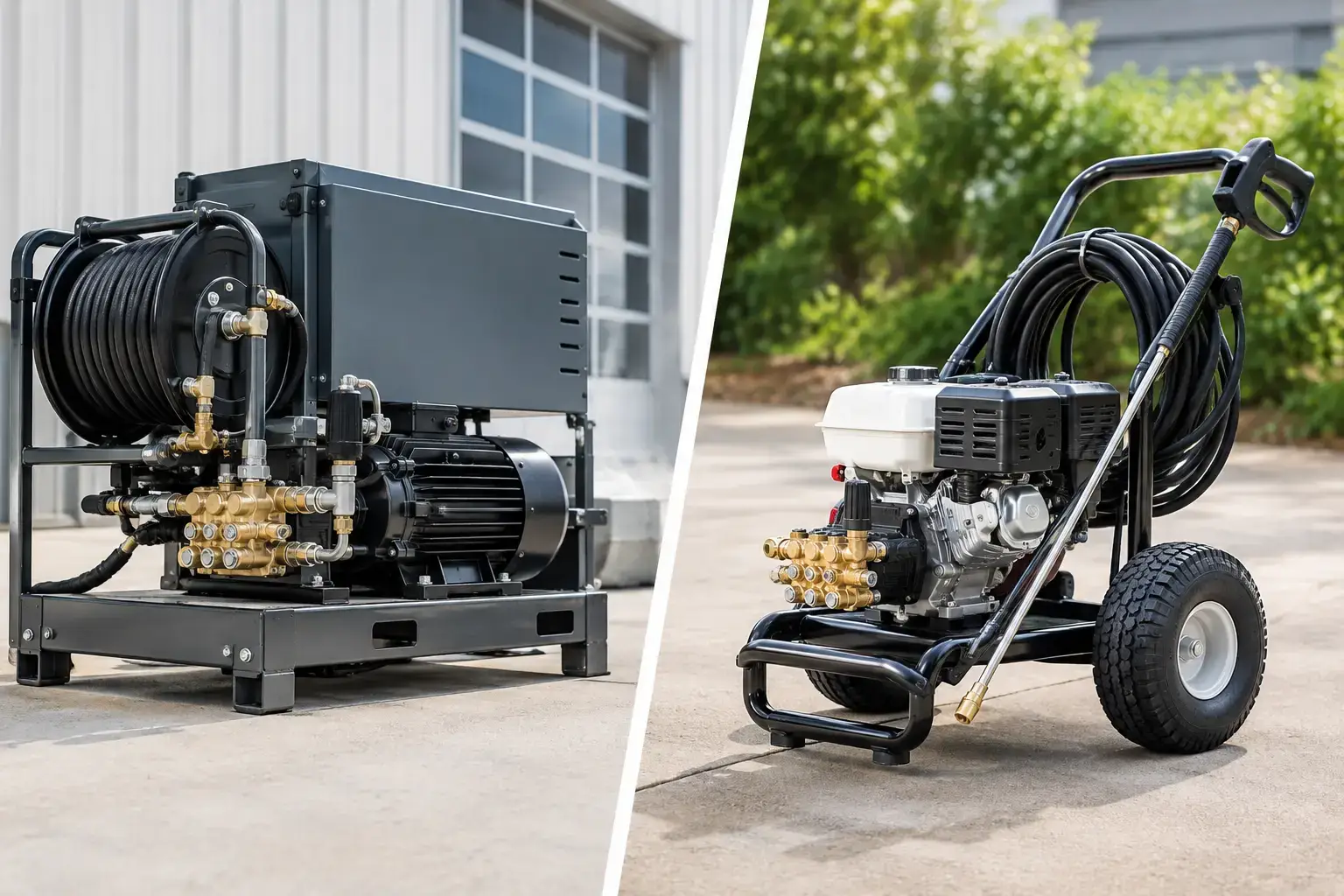
A washer that cannot reach the work is not productive. A washer that gets dragged from bay to bay when the work never moves is not productive either. The decision between stationary versus portable washers is less about machine style and more about how your crew earns revenue, where water and power are available, and how much time is lost every time equipment is repositioned.
Start with the job, not the catalog. A portable unit can be the right answer for a growing exterior-cleaning contractor. A stationary hot-water system can be the better long-term answer for a fleet wash bay running every weekday. Both can be commercial-grade machines. The difference is how well the installation matches the workflow around it.
Stationary versus portable washers: the working difference
A portable pressure washer is built to go where the cleaning happens. It may be a wheel-mounted unit, a trailer package, a skid, or a truck-mounted rig. The machine carries or connects to its own engine, pump, burner, hose, and often a water tank or chemical system. It is designed for variable job sites: homes, equipment yards, construction sites, agricultural properties, restaurant pads, and remote fleet locations.
A stationary washer stays in one place, usually inside a wash bay, maintenance shop, processing area, or dedicated cleaning room. Water, electric power, fuel supply, ventilation, hose reels, and chemical lines can all be planned around that location. The operator walks the hose to the work instead of moving the whole machine.
That distinction changes more than convenience. It affects setup time, maintenance access, safety requirements, fuel handling, hose layout, freeze protection, and the amount of productive cleaning an operator can complete in a shift.
When a stationary washer earns its space
Stationary equipment makes sense when the cleaning comes to the same location repeatedly. Fleet maintenance departments are the obvious example. If trucks, buses, municipal equipment, delivery vans, agricultural machinery, or rental equipment return to a yard every day, a fixed wash station removes a lot of wasted motion.
A properly designed stationary system can place hose reels exactly where operators need them, keep chemical delivery consistent, and eliminate the routine of loading, unloading, fueling, and securing a portable machine. For a crew washing 10 vehicles a week, that difference may be modest. For a crew washing 10 or 20 units a day, it adds up quickly.
Hot water is another reason stationary systems often fit fixed-site work. Grease, oil, animal fats, road film, and heavy equipment soils respond better to heat when the water temperature and flow are matched to the job. A stationary hot-water washer can be built around a dependable fuel supply, correct combustion air, proper flue routing, and the electrical capacity needed for the pump and burner controls. Those details matter. A burner that is starved for air, improperly vented, or fed contaminated fuel becomes a service problem instead of a cleaning solution.
Fixed systems also make winter operation more manageable in Central Pennsylvania. A wash bay can be conditioned, supply plumbing can be protected, and the machine can be installed where it is accessible for regular inspection. That does not eliminate freeze risk. Hoses, reels, exposed piping, and downstream components still need attention. But it is much easier to build freeze protection into one permanent setup than to protect a machine moving between unheated sites.
Stationary systems need a real installation plan
A stationary washer is not simply a portable machine parked against a wall. Before selecting one, look at water volume, drainage, electrical service, fuel type, ventilation, wash-water recovery requirements, hose length, and the distance from the machine to the farthest cleaning point.
Long hose runs create pressure loss, especially when operators add small-orifice nozzles, restrictive guns, or undersized hose. The pump may be rated for the right PSI and GPM, but the operator only experiences what reaches the nozzle. The same goes for water supply. A machine that needs 5 GPM cannot run correctly on a marginal feed line that collapses under demand.
Service access matters too. Pumps need oil changes and seal work. Burners need fuel-system service, electrodes, filters, and combustion checks. Coils eventually scale, leak, or require cleaning. A system installed so tightly that nobody can reach the unloader, float tank, burner, or belt drive is expensive to maintain. Leave room to work on it.
When portable washers are the better business tool
Portable equipment is built for contractors whose work changes address every day. If you wash building exteriors, concrete, dumpsters, agricultural facilities, equipment, or fleets at customer locations, mobility is not a luxury. It is the service.
A wheel-mounted cold-water washer may be enough for short, lighter-duty jobs with reliable water access. A trailer or skid rig becomes more practical as job size, travel distance, and chemical needs increase. It can carry water, soft-wash components, multiple hose reels, surface cleaners, detergent tanks, and a hot-water washer when the work calls for it.
The main advantage is obvious: your cleaning capacity arrives with you. The less obvious advantage is control. A self-contained rig reduces dependence on an unfamiliar customer water source, inconvenient power location, or a hose run that crosses half a property. It also gives an operator a repeatable setup from one site to the next.
Portability does bring more moving parts, literally and operationally. Trailer bearings, brakes, lights, tires, tie-downs, tank mounts, road vibration, freeze protection, and vehicle capacity all become part of the maintenance picture. A washer that rides rough can develop loose fittings, cracked plumbing, rubbed-through wiring, and fuel-system issues that would be less likely in a stationary bay.
Do not confuse portable with undersized
New operators sometimes choose a small portable washer because it is easier to buy and transport. Then they try to use it on recurring commercial work that demands more water volume. PSI gets the attention because it is the larger number, but GPM usually determines how quickly you can rinse, how well a surface cleaner performs, and how much production a crew gets from a day.
For many commercial cleaning applications, a machine in the 4 to 8 GPM range changes workflow far more than a high-PSI, low-flow unit. The right specification depends on the surface, nozzle, water supply, cleaning method, and operator skill. More pressure is not automatically better. Excess pressure can damage siding, wood, mortar, decals, equipment components, and delicate finishes.
Hot water creates another decision point. A portable hot-water washer can be extremely effective for greasy concrete, exhaust systems, shop floors, and equipment maintenance. It also needs disciplined service. Burner failures are commonly traced to fuel quality, ignition components, flow switches, safety controls, inadequate water flow, or a machine being run with problems that should have been corrected earlier. If hot water is central to your business, buy a machine that can be serviced quickly and keep basic wear parts on hand.
Compare uptime, not just purchase price
The cheapest machine is rarely the least expensive machine to own. A lower purchase price can disappear quickly when a crew spends an hour at each job unloading equipment, finding water, untangling hoses, or waiting on a machine that cannot keep up with the workload.
For a fixed wash operation, calculate how many units you clean per day and how much operator time is spent setting up. For a mobile business, calculate drive time, loading time, water availability, and whether a self-contained rig would let you accept jobs that are currently impractical. Those numbers tell you more than a catalog comparison.
Also consider what happens when the machine is down. A portable washer may be your only production unit, which makes a spare gun, hose, nozzle set, filters, unloader repair kit, and routine pump maintenance worthwhile. A stationary wash bay may support several operators or an entire maintenance schedule, so downtime can affect every vehicle waiting to be cleaned.
Dieter’s Industrial sees this regularly in the repair bay: the right repair is not always the cheapest repair, and the right machine is not always the biggest one. If a pump, burner, coil, or engine failure is approaching the value of the unit, replacement may be the honest answer. If the equipment fits the work and the repair restores dependable service, repair can make more sense.
Choose the setup that removes the most friction
Choose stationary equipment when work returns to a dedicated location, operators need consistent access to hot water and chemicals, and a permanent wash bay can be designed around efficient hose and utility management. Choose portable equipment when the job site changes, customer access is unpredictable, or your revenue depends on bringing the full cleaning system to the work.
There is a middle ground as well. Many established contractors run a mobile rig for field work and a stationary washer at their own shop for fleet maintenance, equipment cleanup, and end-of-day servicing. That is not duplication when both machines protect billable hours.
Before committing, map a normal week of work. Track where cleaning happens, how far equipment moves, how much water is needed, what soils you remove, and where delays occur. The best washer is the one that leaves your crew spending more time cleaning and less time working around the machine.