

Choosing a Commercial Pressure Washer That Pays
Buy the wrong setup and the cost shows up in slow production, damaged surfaces, wasted fuel, and repair bills. Start with the job, not the catalog.
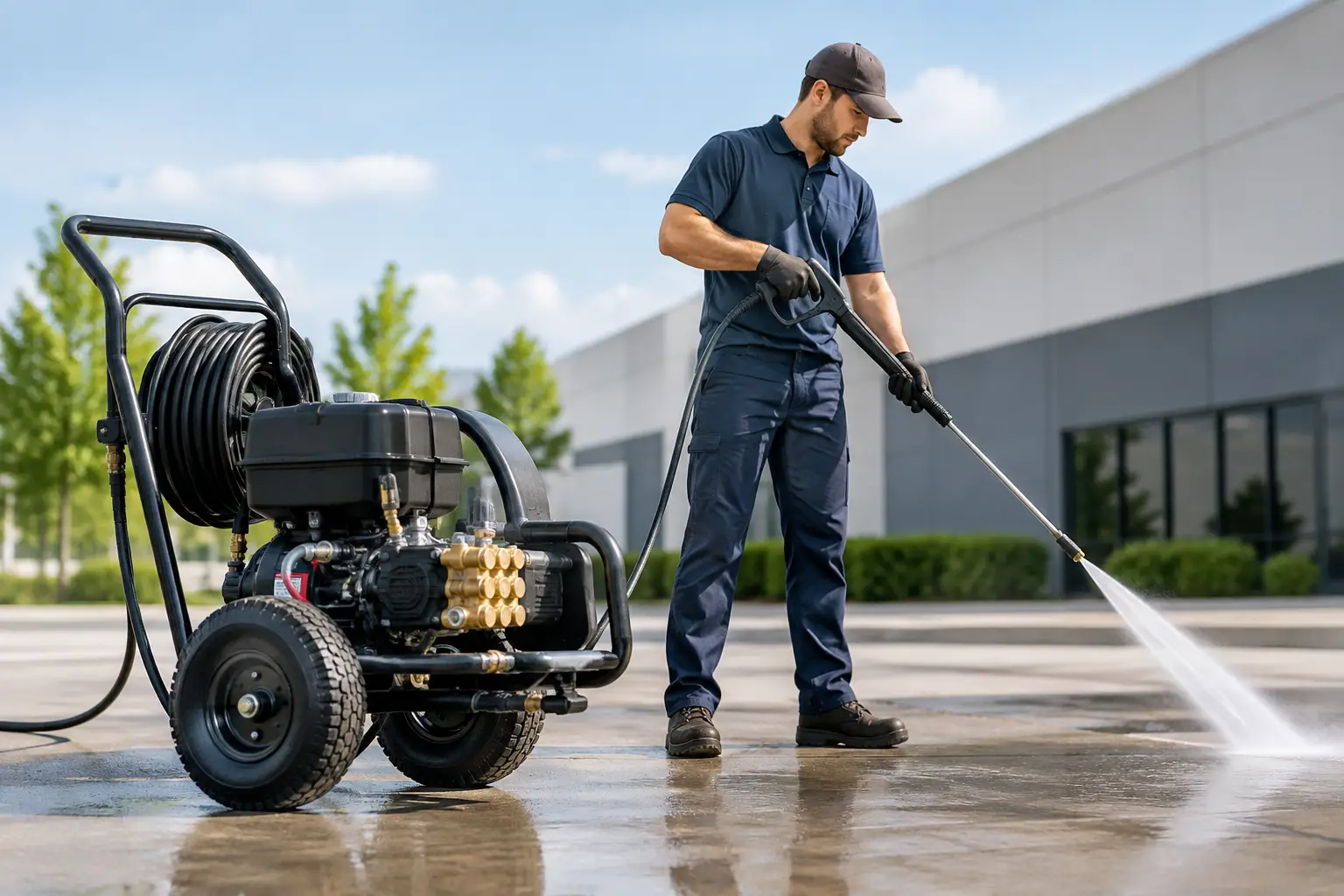
A commercial pressure washer is not just a cleaning tool. It is a revenue-producing machine that has to start, make pressure, apply the right heat or chemical, and stay on the job when a customer is waiting. Buy the wrong setup and the cost shows up in slow production, damaged surfaces, wasted fuel, and repair bills. Start with the job, not the catalog.
The right machine for a restaurant pad is usually not the right machine for house washing. A contractor cleaning fleets all week needs different water flow, hose capacity, and recovery considerations than a property manager handling occasional sidewalk cleanup. PSI gets most of the attention, but GPM, heat, duty cycle, power source, and serviceability usually decide whether a machine earns its keep.
Start With the Work You Are Selling
Before comparing brands or price tags, look at the jobs that will pay for the equipment. Be specific about the soils, the square footage, the water source, where the work happens, and how often the machine will run.
Cold-water equipment is often the sensible choice for general building washdowns, equipment rinsing, concrete prep, mold and algae removal with proper chemistry, and many exterior-cleaning jobs. It is simpler, lighter, and less expensive to buy and maintain because it does not have a burner, fuel system, coil, or heat controls.
Hot water earns its cost when grease, oil, animal fat, heavy fleet grime, food-service buildup, or industrial soils are part of the regular workload. Heat changes the job. It helps break petroleum-based and greasy soils loose so the operator can use less chemical, reduce dwell time, and move faster. For a one-time greasy cleanup, renting or subcontracting may make more sense. For recurring hood, fleet, shop-floor, or food-service work, hot water can pay back quickly.
Also consider whether you are cleaning open pavement, enclosed spaces, job sites without water, or remote agricultural properties. Those conditions determine whether you need a trailer package, skid unit, water tank, hose reel, generator, or a machine built around a particular truck. We walk through that format decision in skid, trailer, or truck mount.
PSI and GPM: Read Both Numbers
PSI is pressure. It helps provide the force needed to dislodge soil. GPM is water flow. It carries the soil away, rinses detergent, and determines how quickly an operator can cover a large surface.
A high-PSI, low-flow machine can feel aggressive at the trigger but still be slow on a broad flatwork job. A higher-GPM machine may clean a large area faster even when the PSI number is lower. That is why a 4 GPM unit and an 8 GPM unit are not minor variations. At 8 GPM, you are moving twice as much water, which affects production rate, water supply needs, hose selection, surface-cleaner sizing, and recovery planning. (More on that in 3,000 or 4,000 PSI? You probably need GPM.)
For many commercial operators, 4 to 5.5 GPM provides a practical starting range. It supports productive cleaning without requiring every job to have exceptional water supply. Larger fleet, industrial, agricultural, and flatwork operations often benefit from 8 GPM or more, provided the site plumbing, tank capacity, and recovery setup can support it.
Do not chase PSI without considering the surface. Too much pressure can scar wood, etch concrete, force water behind siding, strip finishes, and damage vehicle components. The nozzle, spray angle, stand-off distance, flow rate, temperature, and chemical all work together. Pressure is only one part of the cleaning process.
Match Accessories to the Machine
A commercial pressure washer needs properly matched accessories. An undersized surface cleaner will leave production on the table. A nozzle sized incorrectly for the machine can create poor pressure, excessive bypassing, or pump trouble — the nozzle sizing calculator takes the guesswork out. A cheap hose that fails during a route day costs more than the price difference at the counter.
As a general rule, surface-cleaner width should follow available flow, not just the largest deck that will fit in the truck. More GPM can support a wider cleaner and higher production. Proper hose diameter matters too, especially on long runs where pressure loss becomes noticeable. This is where a field-ready package beats piecing together mismatched components.
Choose a Power Source You Can Support
Gas-engine machines remain the standard for mobile cleaning because they can work where electrical service is unavailable. They are a practical fit for fleet routes, exterior washing, agricultural washdown, construction equipment, and remote properties. They also require routine engine maintenance, clean fuel, oil checks, and winter protection.
Electric units make sense indoors or where exhaust, noise, and fuel storage are concerns. They are common in facilities, manufacturing environments, wash bays, and food-related operations. The trade-off is that electrical requirements must be real, not assumed. A machine that needs 230-volt power will not operate properly on a convenient wall outlet, and long undersized extension cords create voltage-drop problems.
For hot-water equipment, consider the burner fuel as carefully as the engine. Diesel, kerosene, natural gas, propane, and oil-fired configurations each have job-site and operating-cost implications. A burner that is improperly adjusted, starved for fuel, or operating with poor airflow will smoke, soot the coil, and eventually become a downtime problem.
Think About Uptime Before the First Breakdown
Commercial equipment works hard. Pumps wear, unloaders stick, hoses fail, injectors clog, valves leak, and burner components eventually need attention. The question is not whether a machine will ever need service. It is whether you can get an accurate diagnosis and the right parts before a failed machine puts a crew on the sidelines.
Look for common, serviceable components: a professional-grade pump, accessible filters, a known engine platform, standard fittings, and parts support that does not require guessing. A lower upfront price can become expensive if every repair turns into a special-order delay.
Pay attention to how the machine handles bypass. When the trigger gun closes, water must go somewhere. The unloader routes that flow, while a thermal relief valve protects the pump from excessive heat during extended bypass. They do different jobs. Operators sometimes replace one when the other is the actual problem, then wonder why the machine still loses pressure or overheats. (Here is how to tell them apart.)
A basic maintenance routine prevents many avoidable failures. Check pump oil according to the manufacturer schedule, inspect inlet filters, keep fittings tight, watch for hose abrasion, use clean water, and winterize before freezing temperatures arrive. On hot-water units, keep burner fuel clean and address smoke, delayed ignition, or fuel leaks immediately rather than running the unit until it stops.
Build for the Next Year, Not Just This Week
New owner-operators often buy for the smallest job they have today. Established companies sometimes overbuy capacity that their crews cannot transport, feed with water, or safely use. The workable middle ground is equipment that covers the jobs you are committed to selling while leaving room for the work you reasonably expect to win.
A compact cold-water unit may be the right first machine for a technician doing residential exteriors and light commercial work. A contractor moving into restaurant pads, fleets, and greasy concrete may need hot water, a larger tank, a hose reel, and a recovery plan before taking on those accounts. The machine is part of a system, not a standalone purchase.
Custom truck and skid configurations are useful when repeat work justifies them. They can organize water storage, chemical application, reels, generators, and hot-water capacity into a package crews can operate consistently. But a custom build should follow a proven workflow. Build around the routes, access restrictions, water use, and cleaning method your business actually uses.
Ask the Questions That Prevent an Expensive Mismatch
A good equipment conversation should cover more than price. What are you cleaning? How many hours per week will the machine run? Is the soil organic, mineral, oily, or greasy? Do you have reliable water and power? Will the equipment stay in a trailer, truck, shop, or wash bay? What happens when it needs a hose, pump seal, burner repair, or replacement nozzle?
At Dieter’s Industrial, the people selling equipment also work on pumps, burners, coils, unloaders, and the rest of the systems that keep machines moving. That changes the recommendation. A machine that looks good on a spec sheet but is poorly suited to the work is not a bargain, and a repair that costs more than replacement value should be called exactly what it is.
Buy enough commercial pressure washer for the work, maintain it like the income-producing asset it is, and keep the right service support within reach. When the next job is scheduled for 6 a.m., that preparation matters more than a bargain price ever will.