

Hot Versus Cold Pressure Washers for Your Work
A cold-water machine can make a clean-looking driveway. It will not necessarily make a greasy fleet chassis, oil-stained loading dock, or equipment wash bay clean enough to meet the standard. That is the real question behind hot versus cold pressure washers: not which machine has more appeal on paper, but which one gets the job done at a cost that makes sense.
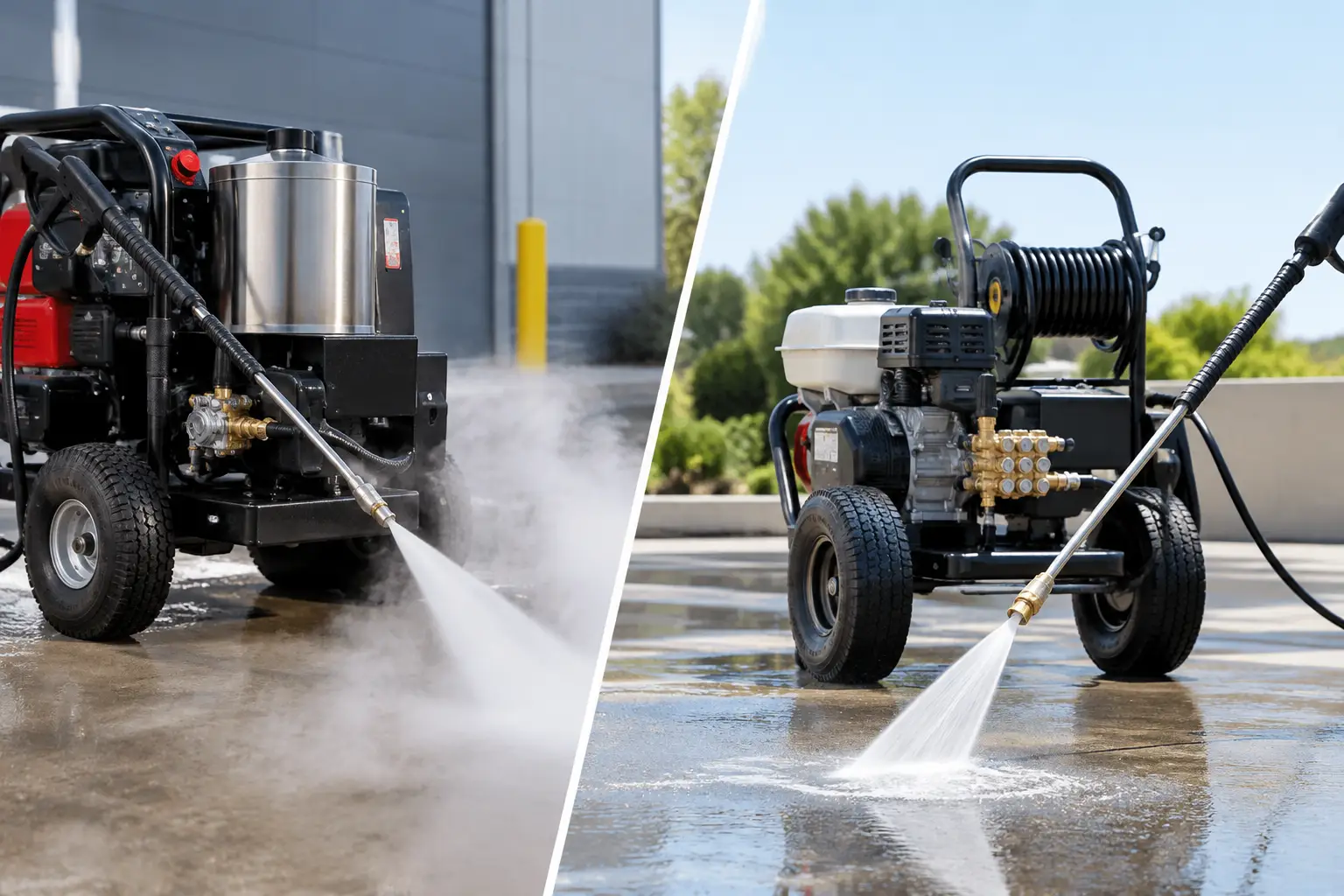
A cold-water machine can make a clean-looking driveway. It will not necessarily make a greasy fleet chassis, oil-stained loading dock, or equipment wash bay clean enough to meet the standard. That is the real question behind hot versus cold pressure washers: not which machine has more appeal on paper, but which one gets the job done at a cost that makes sense.
Start with the soil you are removing, the volume of work, and the consequences of a machine being down. PSI and GPM still matter, but water temperature changes how the machine attacks the mess.
Hot Versus Cold Pressure Washers: The Working Difference
Cold-water pressure washers use mechanical force. The pump sends water through a nozzle at pressure, and the impact breaks loose dirt, mud, loose paint, sand, and other debris. For many exterior-cleaning jobs, that is exactly what is needed.
Hot-water machines add a burner and heating coil after the pump. Water still exits at working pressure, but it is heated first, often to temperatures that can cut through petroleum-based grime quickly. Heat lowers the viscosity of oils and greases, helping detergents work better and allowing the operator to rinse contaminants away rather than repeatedly blasting at them.
Think of washing a greasy skillet. Cold water and elbow grease will eventually do something. Hot water, proper detergent, and less scrubbing get there faster. The same principle applies to a trailer frame covered in road film, a forklift with hydraulic residue, or a restaurant pad carrying animal fat and cooking oil.
That does not mean hot water automatically wins. If the job is mostly mud, mineral buildup, general exterior grime, or paint preparation, a cold-water unit may clean just as effectively with lower purchase cost and less maintenance overhead.
When a Cold-Water Washer Is the Right Tool
Cold-water commercial washers are the workhorses for operators whose jobs are driven by volume, mobility, and straightforward surface cleaning. They cost less up front because there is no burner, fuel tank, coil, ignition system, fuel pump, or burner controls to maintain. They are also lighter, simpler to transport, and generally quicker to diagnose when something goes wrong.
A cold-water machine is usually a strong fit for house washing when paired with a soft-wash setup, concrete cleaning where the soil is not oil-heavy, construction cleanup, agricultural mud removal, deck and fence preparation, and general property maintenance. It is also the sensible starting point for many newer contractors building a route around residential and light commercial work.
Do not confuse simpler with underpowered. A properly sized cold-water washer with enough flow can be highly productive. Four gallons per minute is a workable entry point for many professional jobs, while five to eight GPM can change production rates substantially when paired with the right surface cleaner, hose size, and water supply.
For flatwork, GPM often moves the needle more than chasing extreme PSI. Higher flow rinses faster, supports larger surface cleaners like the Ground Force 24”, and helps prevent the slow, striping-prone workflow that comes from undersizing equipment.
Cold water has limits around petroleum soils
Cold water can remove grease, but usually with more chemical, more dwell time, more passes, or all three. That may be acceptable for an occasional stain. It becomes expensive when grease is the daily workload.
If your crews are spending extra labor fighting engine oil, dumpster-pad grease, hydraulic fluid, heavy road film, or food-service buildup, the lower purchase price of a cold machine can disappear in labor hours and detergent consumption.
When Hot Water Earns Its Cost
Hot-water pressure washers are built for recurring degreasing work. Fleet washing, heavy equipment cleaning, oil-field or industrial maintenance, kitchen-exhaust cleaning, dumpster pads, automotive shops, and agricultural washdown are common applications. In these jobs, heat is not a luxury feature. It is a production tool.
The biggest advantage is speed. Hot water can reduce dwell time and the number of cleaning passes needed to remove oily soils. On a large fleet account or a route with multiple greasy commercial stops, shaving even a few minutes per unit adds up quickly. It can also help a crew use less aggressive chemistry, although the right detergent — a degreaser like Carbon-X on the pad, a fleet soap like Salt Shaker on the trucks — is still part of the process.
Heat also improves results in cold weather. A cold-water machine can still wash in winter when conditions allow, but warm water helps break up winter road film, salt residue, and oily buildup that stiffens in lower temperatures. Operators still need to manage freezing conditions, protect hoses and pumps, and winterize equipment when required. Hot water does not make winter service risk-free. (Washing a fleet in winter covers the routine.)
The Burner System Needs Real Maintenance
A hot-water washer has more components because it is doing more work. Along with the engine or motor, pump, unloader, hoses, and gun found on a cold machine, it has a burner assembly, fuel delivery components, electrodes, safety controls, and a heating coil.
Those parts require inspection and service. Fuel filters clog. Nozzles wear. Electrodes need adjustment. A coil can scale internally when poor water quality is ignored, and it can be damaged if the machine is run improperly. Burner problems are often not mysterious, but they do require a technician who understands the full fuel, air, ignition, and safety-control sequence. (See burner troubleshooting and coil repair for what that work looks like.)
This is where buying on price alone creates trouble. A commercial hot-water unit should be supported with parts availability and technicians who can work on burners, pumps, unloaders, and coils. When a machine is tied to a fleet contract or wash bay schedule, downtime costs more than the repair invoice.
Compare the Costs Beyond the Price Tag
Hot-water equipment costs more to buy, operate, and maintain. It burns diesel, kerosene, heating oil, natural gas, or propane depending on the configuration. It also has more service points. For an operator who only needs heat twice a month, that cost may not be justified.
But operating cost is not the whole calculation. Look at labor, chemical use, throughput, and the kind of work you can sell. If a hot-water unit lets one technician complete a greasy truck wash in 25 minutes instead of 45, it may produce a better return despite higher fuel use.
Cold water generally offers lower ownership cost and fewer repair variables. Hot water offers stronger performance on the soils that slow down crews and eat margins. Neither choice is universally cheaper. The right one depends on what is coming through the door every week.
Size the Machine Around the Job, Not the Catalog
Before choosing hot or cold, settle the specifications. PSI determines impact force. GPM determines how much water is available to carry soil away and how quickly you can rinse. A 4 GPM machine at 4,000 PSI serves a different workflow than an 8 GPM machine at 3,500 PSI, even if the advertised cleaning units look impressive. (The PSI and GPM post and the nozzle calculator help pin those numbers down.)
Water supply matters too. A machine cannot produce its rated output if the source cannot feed it. Long supply hoses, restrictive fittings, inadequate well recovery, and undersized tanks can starve a pump. In a mobile rig, tank capacity, buffer-tank design, hose reels, generator output, burner fuel capacity, and trailer weight all affect whether the system works in the field. (See the water supply guide.)
For hot-water equipment, consider the heat source and installation. Trailer- and skid-mounted units like the BE 5.5 GPM hot skid or the 8.5 GPM commercial skid need enough ventilation and safe exhaust routing. Indoor wash bays may call for electric-heated, natural-gas, or properly vented systems depending on the facility; a 12V hot box added to an existing cold machine is another route to heat on a rig that already has a good pump. Exhaust and carbon monoxide are not details to figure out after delivery.
A Practical Way to Make the Call
A cold-water washer is usually the better purchase when most jobs involve soil, mud, mildew treatment, exterior surfaces, and general cleaning. Put the money into adequate GPM, a quality surface cleaner, proper hoses, and chemicals matched to the work.
A hot-water washer makes more sense when grease and oil are regular revenue sources, when crews repeatedly lose time on degreasing, or when faster turnaround supports a profitable fleet, industrial, agricultural, or food-service contract. If heat only solves an occasional problem, rent, subcontract, or keep a cold-water setup until the workload proves otherwise. A used hot-water unit can also be a sensible first step when the grease work is growing but not yet steady.
Dieter’s Industrial sees both sides in the repair bay. A simpler cold unit is easier to own, but a hot unit that is correctly specified can pay for itself by keeping crews moving through difficult work. Ask what your current machine cannot clean efficiently, what that delay costs per job, and whether heat solves that problem often enough to matter. That answer will point you to the machine that earns its place on the truck. If you want to talk it through against your actual route, call the shop.