

Best Pressure Washer Guns for Commercial Work
A pressure washer gun can look like a simple replacement part until it fails halfway through a fleet contract, locks up after a hot-water job, or leaves an operator fighting trigger fatigue all day. The best pressure washer guns are not necessarily the most expensive models on the shelf. They are the guns correctly matched to the machine, hose, temperature, fittings, and work your crew actually performs.
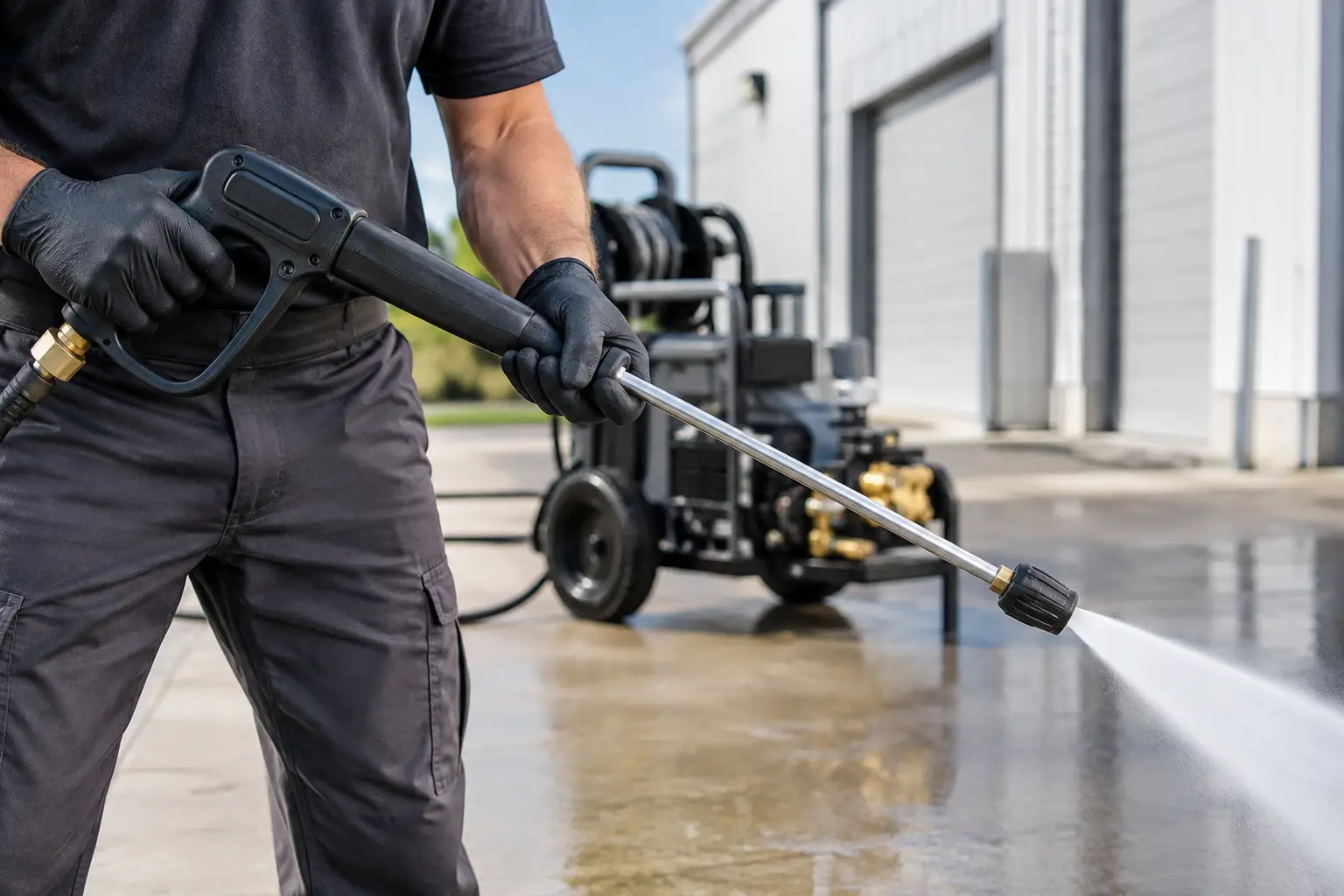
A pressure washer gun can look like a simple replacement part until it fails halfway through a fleet contract, locks up after a hot-water job, or leaves an operator fighting trigger fatigue all day. The best pressure washer guns are not necessarily the most expensive models on the shelf. They are the guns correctly matched to the machine, hose, temperature, fittings, and work your crew actually performs.
For a homeowner machine, a light-duty gun may be good enough for occasional siding or driveway cleaning. For commercial work, the gun is a safety component and a productivity component. It has to handle pressure without leaking, manage heat without cooking seals, and give the operator control without becoming a weak point in the system.
Start With Your Machine Specifications
Start with the job, not the catalog. Then start with the machine’s PSI, GPM, and maximum water temperature. Those three numbers determine whether a gun is appropriate for your setup. (If you are not sure what your machine actually puts out, the PSI vs. GPM guide is the place to start.)
A gun’s pressure rating must meet or exceed the maximum pressure your washer can produce. Do not assume a 4,000 PSI gun is sufficient just because your machine is advertised at 4,000 PSI. Pressure spikes, worn unloaders, and incorrect adjustments can push a system beyond its normal operating range. A reasonable safety margin is cheap insurance compared with a blown hose fitting or a gun failure in an operator’s hands.
Flow rating matters just as much. A gun can be rated for high pressure but still be too restrictive for a high-flow machine. If you are running 8 GPM, 10 GPM, or more on fleet washing, agricultural washdown, or industrial cleaning, use a gun rated for that flow — the WaterBoss 1/2” gun and the GP red wash-down gun are the two we reach for on high-flow rigs. An undersized gun creates unnecessary restriction and can affect unloader behavior, bypass temperatures, and overall machine performance.
Hot-water operators need to read the temperature rating. Many general-purpose guns are built for cold-water service or moderate temperatures. A hot-water skid, trailer, or washer with a burner can send 200-degree water toward that gun. Heat hardens seals, shortens O-ring life, and exposes weaknesses that may not show up on a cold-water unit.
What Makes the Best Pressure Washer Guns Different?
Commercial guns are built around service life and safety, not just a comfortable-looking handle. The right design depends on how the wand is used, how long the operator is on the trigger, and whether the work involves hot water, chemical application, tight spaces, or long reaches.
Rear-entry guns for general commercial cleaning
A rear-entry gun is the standard configuration on many professional pressure washer setups. The hose connects at the rear of the handle, with the lance extending from the front. It is straightforward, durable, and easy to service. For building wash crews, concrete cleaning, equipment washdown, and general fleet work, this is often the sensible choice. The Suttner ST-2305 is the one on most of the rigs that leave our shop; the ST-1500 and ST-510 cover lighter-duty machines.
Look for a forged brass or plated brass inlet, a stainless steel outlet tube, and a trigger assembly with replaceable seals or repair parts available. Cheap guns often fail where the inlet swivels, at the trigger valve, or at the outlet connection. If a gun cannot be repaired or rebuilt, it may not be the best value even if its purchase price is low.
Swivel guns for operators who move all day
A swivel inlet allows the hose to rotate independently of the gun. This reduces hose twist and helps prevent the operator from constantly repositioning the line. On long hose runs, trailer rigs, and fleet accounts where workers are circling vehicles for hours, that reduction in fighting the hose adds up. If your gun does not have one built in, a 3/8” Mosmatic swivel or a 1/2” stainless super swivel at the inlet does the same job.
A swivel does add another moving component, so quality matters. A low-grade swivel can become a leak point or seize when exposed to dirty water, constant heat, or neglected maintenance. For crews working daily, a quality swivel gun is usually worth the added cost. For a machine used once a week in a fixed wash bay, a standard rear-entry gun may be simpler and more economical.
Open guns and weep guns for hot-water systems
This is an area where buying by appearance causes problems. An open gun shuts off flow completely when the trigger is released. A weep gun allows a small amount of water to continue flowing when the trigger is released, helping protect certain hot-water systems from overheating in bypass.
The correct choice depends on the machine’s pump, unloader configuration, thermal protection, and manufacturer requirements. Do not install a weep gun simply because another contractor uses one. It consumes water continuously and may not be appropriate for every setup. Do not install an open gun on a system that requires flow for heat management, either.
If your burner has been shutting down, the coil is overheating, or water is discharging from a thermal relief valve, the gun may be part of the conversation, but it is not automatically the culprit. Check the unloader, bypass routing, thermal relief valve, and operating habits before replacing parts. (Unloader vs. thermal relief valve and burner troubleshooting walk through that diagnosis.)
Fittings and Connections Are Not a Minor Detail
Most gun replacement problems come down to mismatched fittings. Common pressure washer connections include 3/8-inch NPT inlets, 1/4-inch NPT outlets, quick-connect couplers, and metric or proprietary fittings on certain equipment. A gun that physically threads together can still be wrong if the fitting style, seal method, or flow path does not match.
Avoid building a stack of adapters to make an incorrect gun fit. Every extra adapter is another potential leak point, restriction, or failure point. It also makes field repairs harder when an operator needs a common replacement fitting and finds a custom arrangement instead.
Match the inlet to the pressure hose and the outlet to the lance or nozzle holder. Confirm whether the gun requires a male or female connection, whether it seals with pipe thread or an O-ring, and whether the quick-connect size matches your existing tools. On hot-water systems, use fittings and seals rated for the temperature, not just the pressure.
Trigger Feel Matters More Than It Sounds
An operator can pull a trigger thousands of times during a full shift. A stiff trigger, awkward safety lock, or poorly balanced handle will slow down the work and wear out hands and forearms. That matters for productivity, but it also matters for control around painted surfaces, glass, decals, grease, and sensitive equipment.
A gun should have a positive trigger action without requiring excessive hand force. The safety lock should engage reliably but not be so fussy that it gets bypassed or ignored. If your crew wears gloves, test the gun with gloves. If operators work from lifts, around livestock facilities, or in wet wash bays, evaluate grip texture and control in those conditions. The SG35 easy-pull gun exists for exactly this reason: a long day on the trigger.
Short guns like the GP YG5000 and Hydro M407 are useful for close-in work, hood cleaning, equipment cleaning, and tight wash bays. A standard gun with a lance is better for most general work. Specialty setups, including side-handle or dual-lance arrangements, can improve specific cleaning processes, but they should solve an actual field problem rather than create a complicated setup to maintain.
Match the Gun to the Cleaning Application
For flatwork and concrete crews, a durable standard gun with a swivel inlet and a properly sized lance is usually the workhorse. The surface cleaner may do most of the production work, but the gun still handles edges, detail cleaning, gum spots, and rinse-down.
For fleet washing, high GPM capacity, hose management, and hot-water ratings often matter more than a compact profile. Operators move around trucks and trailers constantly, so a swivel gun and a comfortable handle can reduce fatigue and hose damage.
For kitchen-exhaust cleaning or hot-water degreasing, temperature rating and chemical compatibility need close attention. The gun may be exposed to strong degreasers, elevated heat, and frequent trigger cycles. Keep spare seals and a backup gun on the truck. A $100 to $200 component should not stop a night shift with a scheduled account.
For agricultural washdown, durability and serviceability are usually the priority. Mud, manure, mineral-heavy water, and outdoor storage are hard on every component. Choose a gun with proven replacement parts and inspect the trigger, swivel, and fittings before a leak becomes a failure.
Common Gun Failures and What They Usually Mean
A leak at the gun outlet may be a damaged O-ring, a worn quick-connect plug, or a cracked fitting. A leak at the trigger body often points to worn internal seals or a damaged valve seat. A gun that will not shut off cleanly may have debris in the valve, a worn poppet, or a failing trigger assembly.
If the trigger is difficult to pull, do not immediately blame the gun. Excessive system pressure, a blocked nozzle, incorrect nozzle sizing, or an unloader problem can make a good gun feel bad. Check the nozzle first. A nozzle that is too small raises operating pressure and puts unnecessary load on the entire system. (Run the numbers through the nozzle sizing calculator; the won’t-build-pressure post covers the opposite problem.)
Replace a gun when the body is cracked, the trigger mechanism is unreliable, repair parts are unavailable, or repair cost approaches the value of a quality replacement. If the gun is serviceable, rebuilding it with the correct seal kit can be the right call. The answer depends on the gun’s condition and whether it is holding up the crew.
At Dieter’s Industrial, we see the cost of mismatched guns after the fact: burned seals on hot-water machines, leaking adapters, undersized flow ratings, and operators stuck with a machine they cannot safely run. Bring the machine specifications, hose details, and the old gun if possible to the repair counter, or call the shop with the numbers. The right replacement is the one that keeps water moving, protects the equipment, and lets your crew finish the job without losing a day to a preventable part failure. See every gun we stock.