

Trailer Versus Skid Wash Rigs Compared
A rig can make a profitable route easier to run, or turn every job into a loading, parking, and repair problem. The trailer versus skid wash rigs decision is not about which setup looks more professional in a photo. It is about where you work, what you clean, how often you move, and what happens when a hose, burner, pump, or engine needs attention.
A rig can make a profitable route easier to run, or turn every job into a loading, parking, and repair problem. The trailer versus skid wash rigs decision is not about which setup looks more professional in a photo. It is about where you work, what you clean, how often you move, and what happens when a hose, burner, pump, or engine needs attention.
Start with the job, not the catalog. A fleet washer working industrial yards has different needs than a residential exterior cleaner moving through tight neighborhoods. The right platform should protect uptime, keep the operator safe, and leave room to add capacity without creating a rig that is overweight or impossible to service.
Trailer Versus Skid Wash Rigs: The Basic Difference
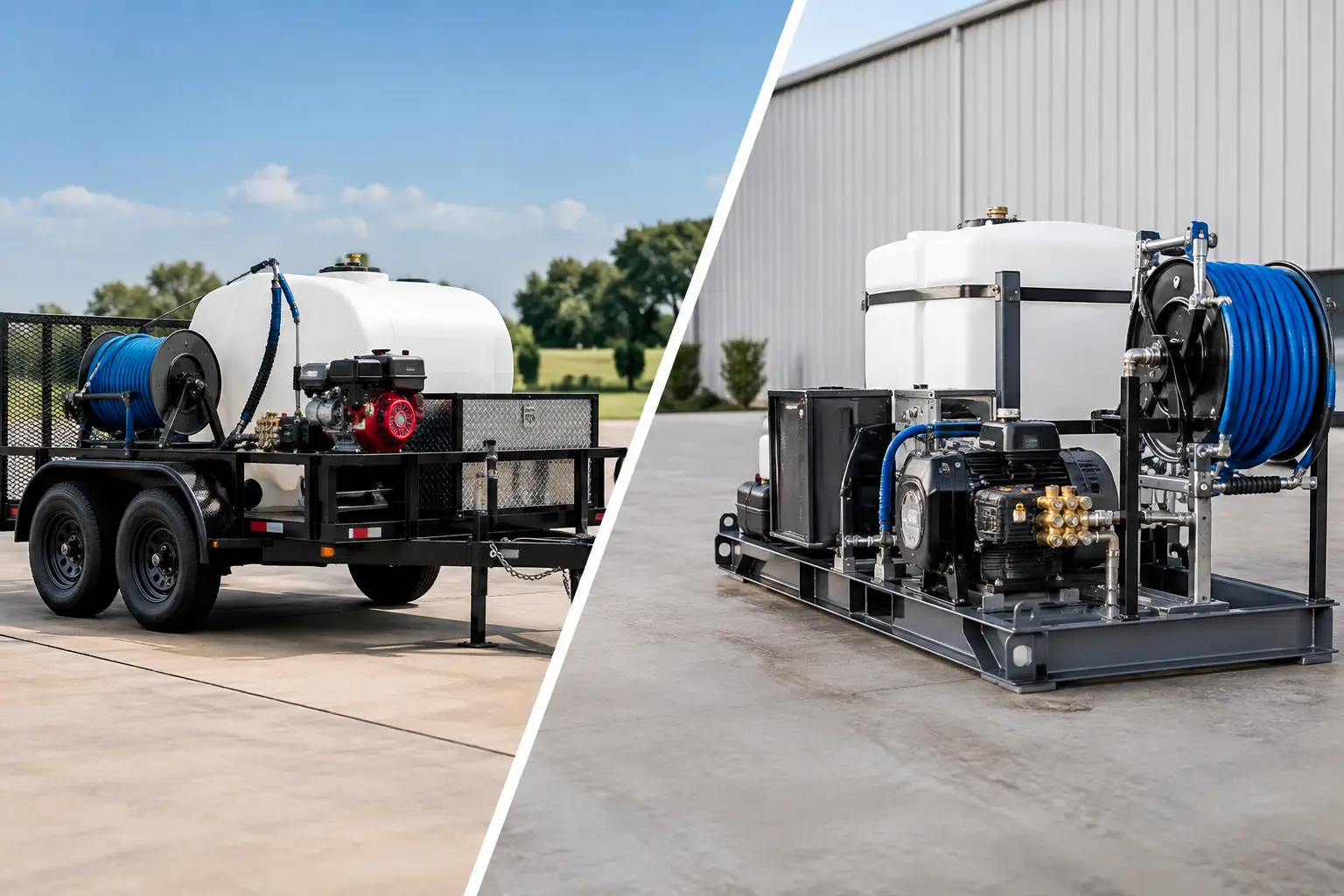
A trailer rig carries the pressure washer, tanks, hose reels, chemical storage, and accessories on its own towable chassis. Your truck or SUV pulls the cleaning system to the job, then disconnects when appropriate. It is a self-contained mobile work platform.
A skid rig is mounted in a truck bed, on a flatbed, inside a van, or on another vehicle platform. The vehicle and wash system operate as one unit. Some skids are compact cold-water systems with a reel and small buffer tank. Others are full commercial builds with hot-water machines, large water tanks, soft-wash equipment, multiple reels, and dedicated chemical storage.
Neither choice is automatically better. The important differences are payload, access, maneuverability, security, maintenance access, and how much work your vehicle needs to do when it is not washing.
When a Trailer Rig Makes More Sense
A trailer is often the practical answer for an operator who needs more water, more equipment, or the flexibility to use the tow vehicle for other work. It can also keep the mess outside the truck bed. Muddy hoses, leaking fittings, chemical residue, and wet tools stay on the trailer instead of inside the vehicle you drive every day.
Water capacity is the biggest reason many contractors move to a trailer. Water weighs about 8.34 pounds per gallon. A 325-gallon tank adds more than 2,700 pounds before counting the trailer, pressure washer, reels, fuel, chemicals, tools, and operator gear. That weight can exceed the payload rating of many pickup trucks quickly. A properly specified trailer distributes that load across its own axle capacity instead of placing it all in the truck bed.
Trailers also provide room to organize a larger operation. A hot-water washer needs space around the burner and coil for safe service. Multiple hose reels need a layout that allows the operator to pull line without climbing over equipment. Larger tanks, reclaim equipment, soft-wash systems, and spare chemical containers all take up real square footage. Trying to force those components into a short-bed pickup commonly creates poor access and difficult repairs later.
For fleet washing, agricultural washdown, construction equipment cleaning, and larger commercial work, that capacity can matter more than the convenience of a compact setup. A trailer can carry enough water to work where a customer cannot supply it, or where flow from the available spigot will not keep up with a high-GPM machine.
The trade-off is towing. You need a vehicle with enough tow rating, braking capability, and wheelbase for the loaded trailer, not just the empty trailer on the sales lot. The trailer needs working brakes, proper breakaway equipment, sound tires, functioning lights, and a hitch matched to the actual loaded weight. It also needs a place to park when it is not on a job.
Parking is not a minor detail. Tight residential streets, crowded shopping centers, narrow service alleys, and some industrial sites can make a trailer a headache. Backing into a loading area or finding room to turn around can cost time before cleaning even starts.
Where a Skid Rig Has the Advantage
A skid is hard to beat when access and speed matter. You arrive, park the truck, pull hose, and go to work. There is no trailer to back, no second registration to manage, and no additional chassis to maneuver around a customer’s property.
This is especially useful for residential washing, storefront cleaning, kitchen-exhaust service, smaller fleet routes, and any work done in dense areas. A pickup-mounted skid like The Ghost mini skid can fit in places where a trailer cannot. If your route includes multiple stops per day, the time saved getting in and out of each location adds up.
Skid rigs can also be easier to secure. Equipment mounted in or on the truck is generally less exposed than a trailer left at a job site, hotel lot, or storage yard. A covered truck bed or enclosed van adds protection from weather and theft, though it must still provide adequate ventilation and safe routing for exhaust, fuel, and heat.
The limitation is payload. Before installing anything, calculate the truck’s payload from the door-jamb sticker and account for every pound. Include the skid frame, machine, reel, hoses, tools, fuel, chemicals, tanks, passengers, and water at full capacity. Do not use a brochure payload number from a different trim package as your final answer.
A skid can be a clean, capable setup with a buffer tank sized to the machine and the job. But a truck bed is not unlimited space. A 5.5 GPM or 8 GPM pressure washer may demand more water than a small onboard tank can supply for long. If you regularly work from tank water, a skid build can reach its practical limit sooner than a trailer.
There is also the work-truck question. A dedicated skid turns your pickup into a dedicated wash vehicle. That is ideal for a growing company with assigned crews. It is less attractive if the same truck must haul materials, pull other equipment, or serve as a personal vehicle on weekends.
Build Around GPM Before You Choose the Platform
PSI gets attention because it sounds impressive. GPM usually has a greater effect on production speed, rinsing ability, and water demand. A 4 GPM machine and an 8 GPM machine do not need the same tank size, hose configuration, or source-water strategy. (The PSI vs. GPM guide covers the trade-off in detail.)
If the site has reliable water flow, a smaller buffer tank may be enough to prevent the pump from being starved when a customer’s supply fluctuates. A 100-gallon slim tank or a 55-gallon tank covers a lot of truck-bed builds. If you clean remote equipment, farm sites, or properties with poor water supply, onboard water becomes part of the job requirement. That pushes many builds toward a trailer.
Hot water changes the planning again. A burner-equipped washer adds weight, fuel storage, heat, and service considerations. The coil, fuel filter, ignition system, flow switch, and burner components all need reasonable access. A machine that is buried behind tanks may look tidy on day one, but it is not a good layout when it needs a nozzle, burner tune-up, coil service, or pump repair.
Dieter’s Industrial sees this problem often: equipment gets mounted so tightly that routine maintenance becomes a major disassembly job. Leave room to reach the pump oil fill, unloader, fuel filter, battery, burner controls, hose connections, and drain points. Service access is part of the build, not an optional extra.
Safety and Layout Are Not Add-Ons
Whether you choose a trailer or skid, secure every component for travel. Tanks need proper mounting and baffling where applicable. Reels need solid mounting points. Batteries, fuel tanks, chemicals, and electrical components must be separated and protected according to their requirements. A loose 250-pound reel or a shifting water tank can damage equipment and hurt someone fast.
Pay attention to weight distribution. A trailer with too much tongue weight can overload the tow vehicle’s rear axle. Too little tongue weight can make the trailer unstable. A truck skid loaded heavy on one side can affect handling, tire wear, and braking. Scale the finished setup if there is any question. Guessing based on how level it looks is not a weight calculation.
Also plan for daily operating details. Where does the operator stand to pull hose? Can they reach the controls without stepping over a hot burner? Where do wet hoses drain? Is there enough room to refill fuel without spilling near chemicals? Can a customer’s water supply connect without routing a hose across a traffic path? Those answers affect how quickly and safely the crew works.
The Cost Question Is Bigger Than Purchase Price
A trailer may cost more once you include the chassis, axles, brakes, deck, storage, registration, and towing requirements. A skid may look less expensive at first, but it can force an upgrade to a higher-payload truck or limit the amount of water and equipment you can carry.
Think about revenue loss as well. If your skid is tied to the only truck you own and that truck goes down, the whole operation may stop. If a trailer has a mechanical problem, you may still have a usable tow vehicle. On the other hand, a skid has fewer separate moving parts to maintain and no trailer tires, hubs, lights, or bearings to inspect.
For a new owner-operator, the best choice is usually the smallest commercial setup that can complete the actual work you have sold, with room for the next sensible step. Something like the 2025 Budget Build is sized that way on purpose. Do not buy a huge trailer because you may eventually need it. Do not overload a half-ton pickup because the compact skid was cheaper.
Choose the platform that lets you arrive safely, clean at the required production rate, and service the equipment without tearing the rig apart. The rig should support the work, not become another job waiting in the parking lot. If you want to talk it through, we build skids and trailers in Lewisberry — spec one in the Rig Builder or ask for a quote. For the three-way version of this question, including truck mounts, see Skid, trailer, or truck mount for a two-man crew.