In stock


A pump rebuild can put a commercial machine back to work, but it is not automatically the right answer. The real question is whether the pump has a sound foundation and whether the repair protects more revenue than it costs.
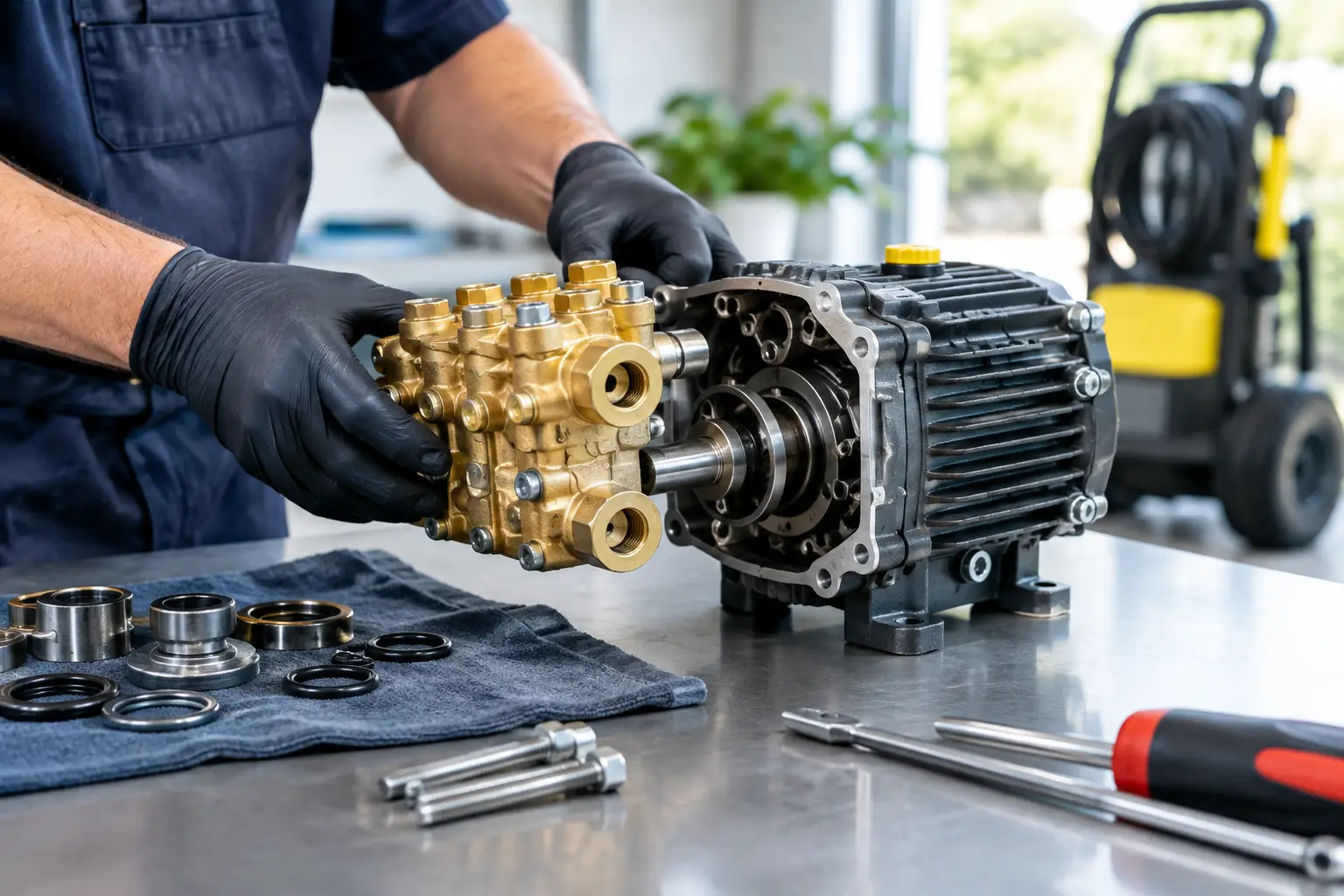
A pump failure rarely happens when the schedule is open. It shows up halfway through a fleet wash, on a greasy kitchen-exhaust job, or when a crew is already parked at a farm. A pressure washer pump rebuild service can put a commercial machine back to work, but rebuilding is not automatically the right answer. The real question is whether the pump has a sound foundation and whether the repair protects more revenue than it costs.
For professional operators, a pump is not just a replaceable part. It determines whether the machine can maintain the PSI and GPM required to move through a job at a profitable pace. Before ordering seal kits or a replacement pump, start with a proper diagnosis.
A legitimate rebuild is more than replacing a few leaking seals. The pump has to come apart far enough to determine why it failed, what else was damaged, and whether the major components can still hold tolerances.
On a triplex pump, a technician generally inspects the manifold, inlet and discharge check valves, valve seats, packings, plungers, seals, crankcase oil, connecting rods, bearings, and crankshaft. The unloader, thermal relief valve, inlet plumbing, hose, gun, and nozzle also need attention. A pump can fail because of an internal wear problem, but it can also be damaged by a bad water supply, a stuck unloader, a nozzle that is too small, or repeated bypass operation.
The rebuild itself may involve replacing packings and seals, valve assemblies, O-rings, plungers, retainers, and crankcase components as needed. The manifold is checked for cracks, erosion, and freeze damage. After reassembly, the pump should be tested under water flow and operating pressure, not simply spun over on a bench.
That last step matters. A pump that looks fine with no load can still surge, bypass excessively, leak at operating temperature, or fail to make rated pressure once it is connected to the rest of the machine.
A rebuild is usually worth considering when the pump is a commercial-grade unit with a healthy crankcase, an undamaged crankshaft, and a manifold that is not cracked or badly eroded. Quality triplex pumps are built to be serviced. If the failure is limited to normal wear items such as packings, valves, or seals, rebuilding can be a practical way to get more life from the machine.
It also makes sense when the pump is correctly matched to the engine or motor and the rest of the equipment is in good shape. Replacing a serviceable commercial pump with a lower-cost pump can create a different set of problems: wrong shaft size, incorrect RPM, inadequate GPM, or an unloader setup that does not behave properly.
Age alone does not decide the issue. A ten-year-old pump with clean oil, a solid crankcase, and available parts may be a better rebuild candidate than a newer pump that ran dry, froze hard, or operated for months with contaminated water.
For a contractor with a specialized hot-water skid, custom rig, or machine built around a particular pump configuration, rebuilding can also avoid the downtime and fabrication involved in adapting a replacement pump.
There is a point where putting money into a pump becomes a bad business decision. Severe crankcase damage, broken connecting rods, a scored crankshaft, stripped threads, cracked manifolds, or unavailable internal parts can make replacement the sensible route. So can repeated failures that point to deeper equipment issues.
Freeze damage is one of the common deal-breakers. A cracked manifold may be visible, but smaller freeze cracks can open only when the pump is under pressure. If the manifold has split in several places or the cost of a new manifold plus wear parts approaches the price of a complete pump, it is time to compare options honestly.
The same goes for a pump that has been run dry long enough to score plungers, overheat seals, and damage valves. A partial repair may get it running, but it can leave you with a machine that returns to the repair bay after the next heavy job.
This is where a written estimate is useful. You need to see the cost of the required repair, the condition of the rest of the machine, and the cost of a properly matched replacement. At Dieter’s Industrial, the goal is not to sell a rebuild at any cost. If replacement is the better value, that should be said before parts start going into the pump.
Low pressure does not automatically mean the pump needs rebuilding. Start outside the pump, where simpler problems often live — six things to check, in order walks through them. A worn nozzle increases orifice size and can make a healthy pump look weak. An air leak on the inlet side can cause pulsing and loss of pressure. Restricted inlet filters, undersized supply hoses, weak water flow, or a clogged injector can produce similar complaints.
Once those basics are checked, pump-related symptoms become more meaningful. Water leaking from the manifold or from between the manifold and crankcase can indicate failed packings, seals, or a damaged plunger. Milky crankcase oil points to water intrusion and needs attention before bearings and rods suffer. Pressure pulsing may come from worn or sticking valves, trapped debris, inlet starvation, or an unloader problem.
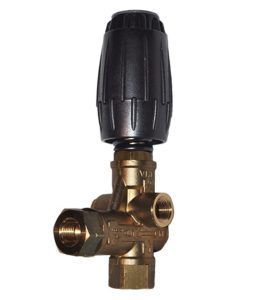
A pump that makes pressure but gets hot quickly may be spending too much time in bypass. That is not always a pump rebuild issue. A thermal relief valve protects the pump from overheated bypass water, while the unloader controls where water goes when the trigger gun is released. Confusing the two leads to bad diagnoses and unnecessary parts replacement — here is how to tell them apart.
Most pump damage starts with operating conditions, not a defective pump. Leaving a machine in bypass for extended periods cooks water inside the pump. Running without adequate incoming water starves packings and valves. Freezing water in the manifold cracks expensive components. Dirty water wears valves and seals faster than normal.
Incorrect nozzles cause trouble as well. A nozzle that is too small can over-pressurize the system. One that is too large can make the operator think the pump has lost output. Either condition affects cleaning performance and can complicate troubleshooting. The nozzle sizing calculator gives the right orifice for your machine's PSI and GPM.
Chemical exposure is another factor. Downstreaming is generally easier on the pump than pulling strong chemicals through it, but chemical compatibility still depends on the setup, dilution, dwell time, and rinse practices. Operators using soft-wash blends, degreasers, acids, or specialty cleaners need equipment selected for that chemical duty rather than hoping a standard pump will tolerate it.
Bring the complete symptom history with the machine. Tell the technician whether pressure dropped suddenly or gradually, whether the pump froze, whether oil changed color, how often the machine runs in bypass, and what nozzle size is installed. That information can save diagnostic time and prevent a repeat failure.
If possible, bring the hose, gun, and nozzle or provide the machine’s PSI, GPM, engine or motor speed, and pump model. A pump has to be evaluated as part of a system. Installing good rebuild parts will not solve an inlet restriction or a misadjusted unloader.
After repair, protect the work. Check oil at the service interval recommended for the pump and replace it if it becomes milky or contaminated. Keep inlet strainers clean. Use a water source that can supply the machine’s GPM. Winterize before freezing weather, not after the first cold night. And avoid using the trigger gun as a pause button for long stretches.
The cheapest repair is not always the one that keeps a crew productive. A proper pressure washer pump rebuild service should answer three practical questions: what failed, why it failed, and whether the repaired pump is likely to hold up in the work you actually do.
If the pump has a sound core and normal wear caused the problem, rebuilding can be a smart use of money. If major damage, poor parts availability, or repeat failures are involved, replacement may protect your schedule better. Make the call with the machine’s workload, repair estimate, and next job in mind — then keep water moving through the system the way it was designed to run.
Everything the guide mentions, on the shelf in Lewisberry and shipped same day on orders in by 2 pm.
If the checks above did not get it running, stop throwing parts at it. Drop it at the shop in Lewisberry or ship it in, we diagnose it, and you get a number before any work starts. Every brand, not just the ones we sell.
We will pre-fill "Pump noise or damage" on the form — change it if that is not quite it.