

Commercial Wash Bay Design Guide for Uptime
A wash bay can look finished and still cost you money every day. Start with the jobs moving through the bay and the wastewater leaving it.
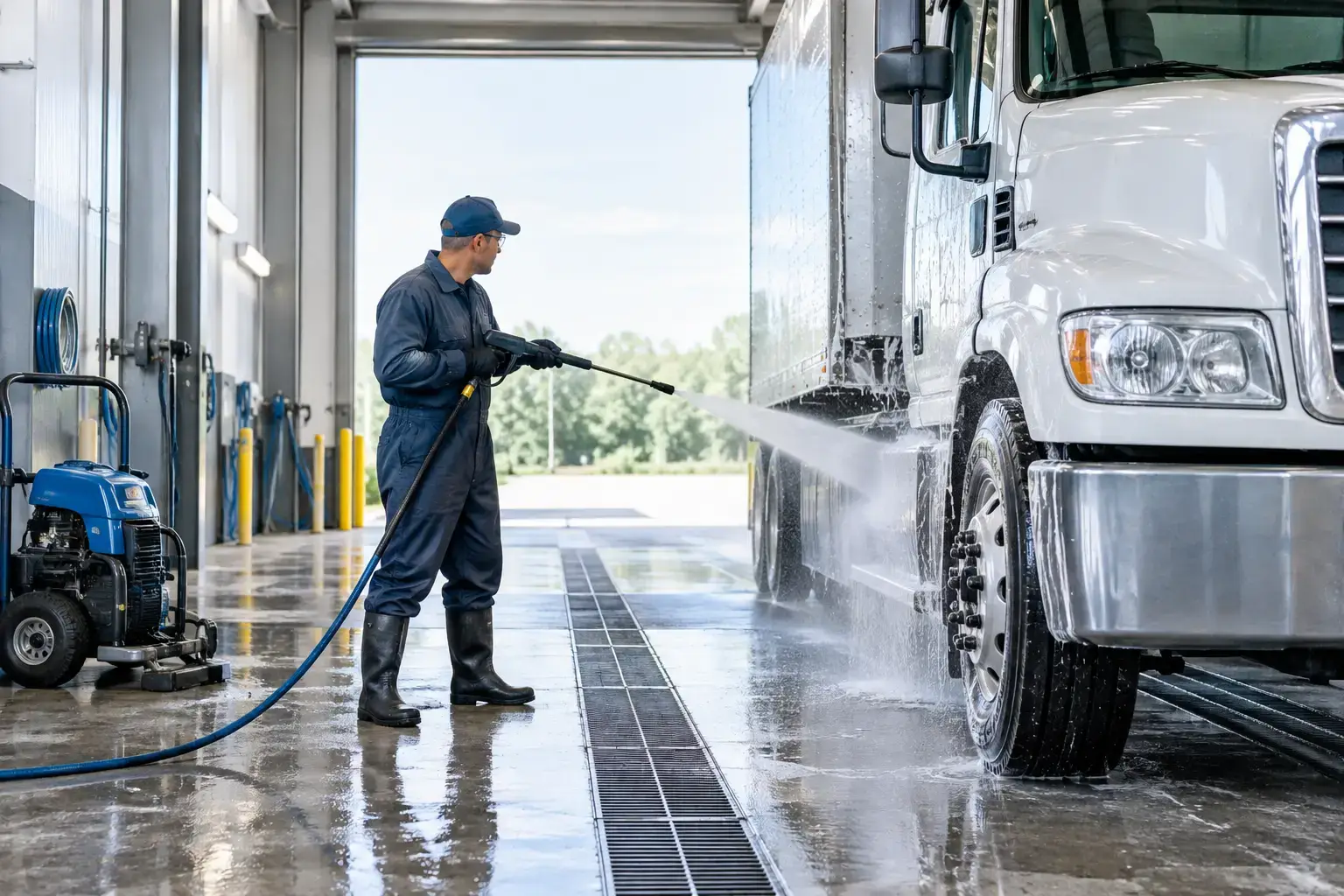
A wash bay can look finished and still cost you money every day. The usual trouble spots are not the walls or the pressure washer. They are standing water at the door, undersized drainage, poor vehicle flow, frozen lines, inadequate electrical service, and equipment boxed into a corner where nobody can service it. This commercial wash bay design guide starts where a working contractor or fleet manager should start: with the jobs moving through the bay and the wastewater leaving it.
Start With the Job, Not the Building
Before laying out drains or shopping for a pressure washer, define what enters the bay, how dirty it is, and how many units need to move through per day. A fleet washing road film and salt has different needs than an agricultural operation washing manure and bedding, or a contractor cleaning greasy equipment after a construction job.
Measure the largest vehicle or piece of equipment you expect to wash, then account for doors, mirrors, open compartments, hose reach, and the person doing the work. A bay sized only for the vehicle footprint forces operators to work too close to walls and constantly reposition hoses. That adds time to every wash and increases damage to reels, guns, and fittings.
Think through traffic before committing to a layout. A drive-through bay usually keeps production moving better than a dead-end bay because vehicles do not need to back out over wet floors. A dead-end arrangement can still make sense where the building or site limits access, but it needs enough clear space for safe backing and staging. If trucks wait in line, provide a place for them that does not block the exit or force runoff toward clean areas.
For higher-volume operations, separate dirty staging, washing, final rinse, and dry or inspection areas whenever practical. This prevents freshly cleaned equipment from rolling through the same mud, salt, and wash water that came off the last unit.
Commercial Wash Bay Design Guide: Drainage First
Drainage is the part nobody sees after construction, and it is the part hardest to correct later. The floor needs a deliberate slope to trenches or drains, not a vague promise that water will find its way out. Even minor low spots become standing-water areas that collect sand, grease, detergent residue, and ice in winter.
Trench drains generally work well across the width of a bay or near the exit because they capture water over a broad area. Point drains can work in smaller bays, but they demand more accurate floor slopes and are easier to miss with washdown water. Select grates rated for the actual traffic load, including loaded trucks, forklifts, trailers, and skid steers. A light-duty grate may survive for a while, then fail when a driver turns tires over it repeatedly.
Plan access for cleaning the drains. Grit, leaves, animal waste, sediment, and paint chips will settle out somewhere. If the drain system has no basket, sump access, or cleanout strategy, the bay will eventually flood at the worst possible time.
Wastewater rules are local and job-specific. Do not assume a floor drain can discharge to a storm drain, a septic system, or the nearest ditch. Many commercial wash operations require connection to sanitary sewer with approval from the local authority, and some need pretreatment before discharge. Oil-water separation may be part of the system, but it is not a cure-all. Emulsified oils, detergents, degreasers, metals, and high solids can create discharge problems that a basic separator will not solve.
Get the wastewater plan reviewed before concrete is poured. Talk with the municipality, sewer authority, environmental consultant, and a qualified plumber or civil contractor as needed. The correct design depends on what you wash, what chemicals you use, expected volume, and local discharge limits. A cheap drainage decision can become an expensive excavation project later.
Size the Equipment Around GPM and Recovery Time
Pressure gets attention because PSI is easy to advertise. In a production wash bay, gallons per minute often matters more. GPM determines how quickly you can rinse away detergent and contamination. High PSI with low flow can cut stubborn soil, but it may be slow on large fleet surfaces. More flow usually means faster rinsing, more runoff, and greater demand on drainage and water supply.
For general vehicle and equipment washing, choose the machine based on the soil load, cleaning method, and number of operators. One operator washing a few units per day may be well served by a properly sized single pressure washer. Multiple operators, frequent fleet turns, or dedicated wash staff may justify a central system, multiple machines, or a stationary unit with hose drops and reels.
Hot water earns its keep when oil, grease, heavy road film, and food-service soils are part of the work. It can reduce chemical use and dwell time, but it brings burner maintenance, fuel supply, ventilation requirements, and winter operating considerations. Cold water equipment is simpler and often adequate for mud, general exterior washing, and many rinse-heavy jobs. Do not buy hot water just because it sounds commercial, and do not rule it out when the job is grease.
Build room around the equipment. Pumps, burners, coils, filters, unloaders, belts, fuel components, and electrical controls all need service access. A machine tucked behind a tank or permanently blocked by shelving turns a straightforward repair into a major shutdown. At Dieter's Industrial, that is the kind of installation issue the repair bay sees after the fact.
Plan Utilities for Real Operating Conditions
Water supply is often undersized in otherwise well-planned bays. Check the available flow and pressure while other building demand is active. A machine that needs several gallons per minute cannot perform correctly if the supply line starves it. Starvation can cause pressure fluctuations, cavitation damage, and premature pump failure.
Install shutoffs where they are accessible, filtration where incoming water quality calls for it, and freeze protection anywhere lines are exposed to cold. In Central Pennsylvania, winter is not a theoretical concern. A heated bay helps, but hoses, reels, supply lines, chemical tubing, and exterior connections still need a plan for overnight temperatures and shutdown periods.
Electrical requirements should be determined by the actual equipment package, not guessed from the current panel. Electric pressure washers, pumps, heaters, lighting, exhaust fans, water recovery equipment, and future expansion can add up quickly. Use properly rated wiring, disconnects, and ground-fault protection where required. If the bay uses gas-fired or diesel-fired heating equipment, provide the required combustion air and ventilation. Carbon monoxide is not a maintenance problem. It is a life-safety problem.
Chemical storage deserves the same attention. Keep detergents where operators can reach them without dragging containers across traffic lanes, but protect them from freezing, direct heat, and vehicle impact. Secondary containment, clear labeling, and compatible plumbing make daily work safer and reduce expensive mix-ups.
Build the Bay for the Operator
The best wash bay layout reduces wasted motion. Hose reels should cover the work area without forcing an operator to pull excess hose through standing water. Mount them high enough to protect them from bumpers and forks, but low enough for practical service. Use swivel connections and hose lengths that suit the bay instead of adding extensions until the setup becomes a tangled tripping hazard.
Lighting matters more than most owners expect. Operators need to see missed film on white paint, oil around hydraulic fittings, salt trapped under frames, and damaged hoses or couplers. Bright, protected fixtures with minimal shadowing make quality control easier. Choose wall finishes that tolerate repeated washdown and chemical exposure, then protect corners, posts, and equipment areas from vehicle contact.
Safety equipment should be placed where it can be used immediately, not where it looks tidy on a drawing. That includes emergency shutoffs, eyewash equipment when chemicals require it, spill materials, fire extinguishers, and clearly marked walkways. Use slip-resistant floor finishes or treatments appropriate for wet, detergent-exposed surfaces. A glossy floor may look clean on opening day and become a liability after the first busy winter.
Leave Room for Maintenance and Change
Commercial wash work changes. A contractor adds a second crew. A fleet grows. A customer brings in larger equipment. Chemical requirements change. Design with spare capacity where the budget allows: room for another reel, capped plumbing for a future machine, electrical capacity for added equipment, and clear access to drains and utility chases.
That does not mean overspending on every possible upgrade. It means avoiding choices that lock the operation into a small, hard-to-service setup. Spend money first on drainage, safe utilities, durable surfaces, and equipment access. Those decisions protect uptime long after the new paint and signage stop being new.
A working bay should make the next wash easier than the last one. If your operator can pull in, clean effectively, manage wastewater properly, service the equipment without moving half the room, and pull out without creating a bottleneck, the design is doing its job.