

Pressure Washer Tanks for Commercial Rigs
A tank decides whether your pump stays fed, whether the rig is safe on the road, and whether the crew finishes when the customer's water is weak. Here is how to pick one and plumb it so it never starves the pump.
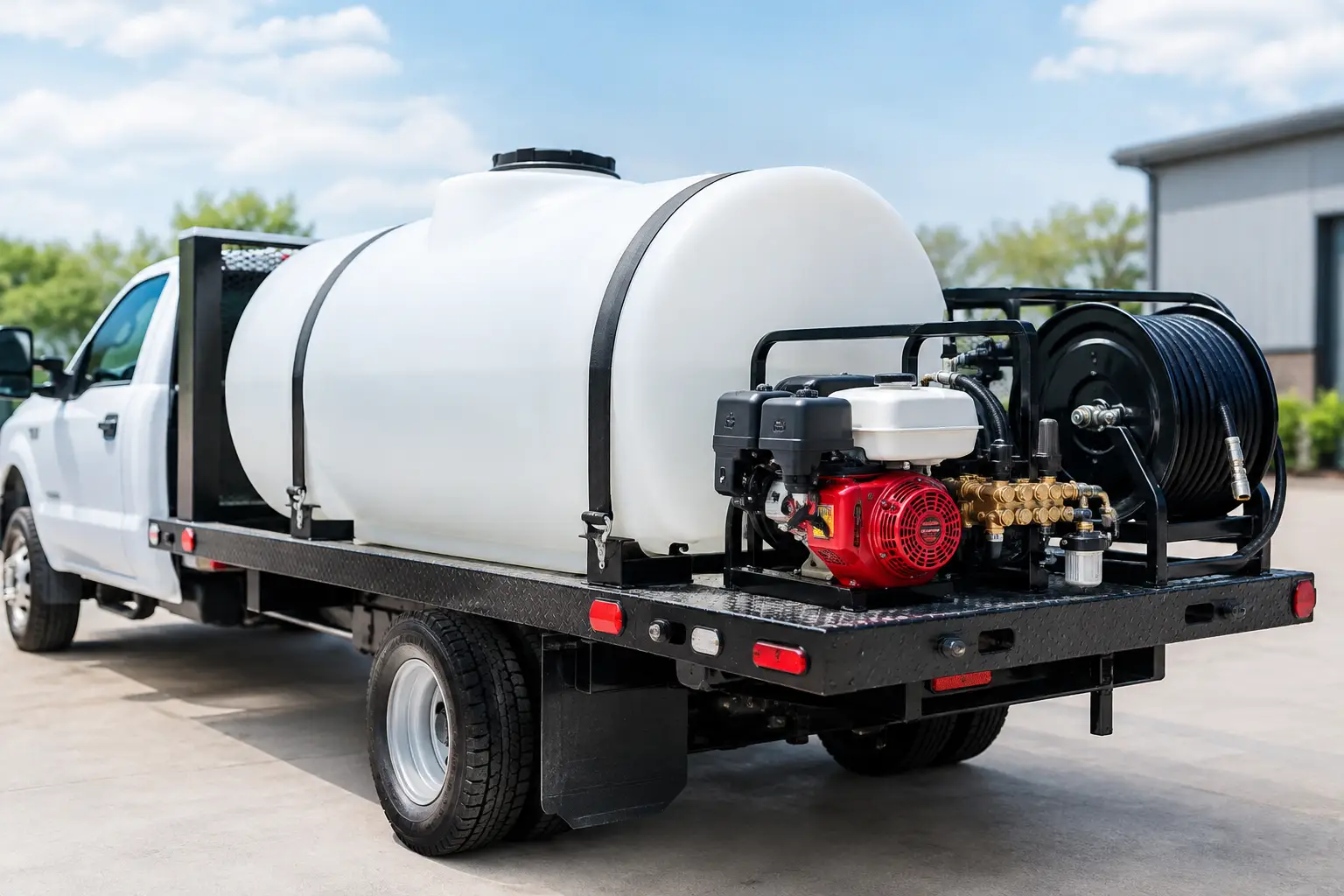
A tank is not just extra capacity bolted to a trailer. Pressure washer tanks determine whether your pump stays fed, whether the rig handles safely on the road, and whether your crew can finish a job when the customer’s water supply is weak or unavailable. Get the tank wrong and you can create pump starvation, cracked mounts, chemical contamination, or a trailer that is overloaded before the workday starts.
Start with the job, not the catalog. A fleet-washing contractor who connects to hydrant-fed water has different needs than a property maintenance crew working from a remote lot, and both are different from a soft-wash operation carrying several chemical mixes.
Choosing Pressure Washer Tanks by the Job
The first question is what the tank needs to hold. Most commercial rigs use one or more of three types: a fresh-water buffer tank, a chemical tank, and a fuel tank for a hot-water burner. They may all look like polyethylene tanks from a distance, but they have different plumbing, fittings, venting, and compatibility requirements.
A fresh-water tank gives the pressure washer pump a consistent water supply. This matters when a customer’s spigot cannot keep up with an 8 GPM machine, when inlet pressure varies, or when you need to work away from a water connection. It also gives crews a practical reserve for rinsing, washing equipment down, or handling a short interruption in supply.
Do not mistake a buffer tank for an unlimited water source. A 100-gallon tank feeding an 8 GPM washer holds roughly 12 minutes of water if it is not being replenished. Real-world run time is usually longer when the tank is filling during use, but the math still matters. If your crew regularly works locations with no water, tank capacity must be based on actual washing time, expected refill access, and the weight your vehicle can legally carry.
Water weighs about 8.34 pounds per gallon. That means 100 gallons adds more than 830 pounds before the tank, frame, hose reels, washer, burner, tools, and chemicals are counted. A large tank can solve one problem while creating another if the truck, trailer, axle ratings, tires, or brakes are not sized for the loaded rig. It also changes handling. A partially filled, unbaffled tank lets water move under braking and through turns, which is not something you want on a loaded service trailer. (Skid, trailer or truck mount covers the payload side of that decision.)
For most professional cleaning rigs, the right capacity comes down to workflow. A 50- to 100-gallon buffer tank may be enough for a contractor who normally has reliable customer water and wants to protect the pump from a weak supply. A 200- to 500-gallon tank makes more sense for remote cleaning, agricultural work, or jobs where setup time and water access are unpredictable. Bigger is not automatically better. It costs payload, takes up space, and can leave stale water sitting in the rig between jobs.
Tank material and shape matter
Rotomolded polyethylene is common because it resists corrosion, is comparatively light, and works well for water and many cleaning chemicals. The key word is many. Sodium hypochlorite, degreasers, acids, solvents, and specialty restoration chemicals do not all belong in the same tank with the same fittings.
Use a tank rated for the chemical being carried and match the plumbing to it. A tank may survive a product while a cheap bulkhead fitting, valve seal, hose, or strainer fails first. For sodium hypochlorite service, chemical-rated components and regular rinsing are not optional. For acidic products, confirm the tank and fitting compatibility before filling it. Guessing based on what worked with a different detergent is how leaks start.
Tank shape affects mounting and available space. Horizontal leg tanks are common on trailers because they keep weight relatively low and are easier to strap down. Vertical tanks can save floor space, but they raise the center of gravity. Low-profile tanks are useful when clearance, sightlines, or ladder racks matter. Choose the shape that suits the vehicle and load plan, not the one that happens to be in stock.
Mounting and Plumbing Pressure Washer Tanks
A tank needs a proper foundation. Mount it on a flat, supported surface that will not flex under a full load. Use tank straps or a purpose-built cage that secures the tank without crushing it. Do not rely on a few ratchet straps run through convenient openings, and do not bolt through a polyethylene tank unless the manufacturer specifically designed it for that method.
Leave room to inspect fittings, clean around the tank, and reach valves in an emergency. A shutoff valve that cannot be reached quickly is not much use when a fitting breaks. Make sure fill caps, vents, and drain points remain accessible after hose reels, toolboxes, and ladder racks are installed.
The pump inlet side deserves more attention than it usually gets. Commercial triplex pumps need adequate water volume at the inlet. Restrictive fittings, undersized hose, dirty inlet filters, sharp bends, and partially closed valves can cause cavitation. That can sound like rattling or gravel in the pump, and it can damage valves, seals, and plungers — the kind of damage that ends in a pump rebuild.
Use adequately sized supply plumbing from the tank to the pump. The exact size depends on machine GPM and plumbing layout, but the inlet line should not choke the pump. Keep runs short and direct where possible. Use full-port ball valves, a properly sized inlet strainer, and fittings that do not reduce the inside diameter unnecessarily; reinforced suction hose on the inlet run will not collapse the way a garden hose can. A tank vent is equally necessary. Without proper venting, the pump can pull a vacuum against the tank and starve itself even when plenty of water remains inside. (If the machine is already acting starved, start with why a pressure washer won’t build pressure.)
Gravity feed is generally simpler and more dependable than asking the washer pump to pull water uphill through a long line. Position the outlet low enough to feed the pump, but protect the fitting from road debris and accidental impact. If the layout requires a transfer pump or booster arrangement, size it correctly and build in a way to service it. Extra components can solve difficult installation problems, but they also add failure points.
A float valve on the tank fill line can help prevent overfilling while the rig is connected to customer water. It should be treated as a convenience, not as a reason to walk away from a filling tank. Inspect it regularly. Debris, worn seals, and freezing conditions can all turn a float valve into a leak.
Separate water, chemical, and fuel systems
Fresh water should stay fresh. Do not use a water buffer tank as a chemical mixing tank unless that is specifically the system design and every downstream component is rated for it. Cross-contamination can ruin a job, damage a pressure washer, and create a disposal problem.
For downstream chemical injection, the washer draws detergent after the pump through an injector. The chemical tank needs a pickup tube, a suitable filter, and chemical-rated hose. For soft washing, chemical moves through a dedicated pump and soft-wash hose system, not through a standard pressure washer pump. Keeping these systems separate makes troubleshooting easier and prevents expensive corrosion damage. (When the injector stops pulling product, this post walks the usual causes.)
Hot-water machines add another tank to think about: diesel or kerosene fuel for the burner. Keep fuel plumbing protected, use approved components, and do not crowd fuel lines against hot burner surfaces or exhaust areas. A hot-water skid that looks tidy but traps heat around plastic tanks and hoses will not stay tidy for long. Burner troubleshooting covers what goes wrong on the fuel side.
Maintenance That Protects Uptime
Tanks are low-maintenance, not no-maintenance. Check straps, mounting points, fittings, valves, and hose connections at the start of the season and after rough transport. Look for stress whitening around fittings, bulging, abrasion where a tank rubs against a frame, and slow drips that leave chemical residue.
Clean inlet strainers often. A restricted strainer can mimic a pump problem, and it is far cheaper to clean a screen than rebuild a pump that has been run dry or starved for water. Drain and flush water tanks periodically, especially if the rig sits for weeks. Sediment settles at the bottom and eventually finds its way to valves, filters, and pump inlets.
Winter changes the routine in Central Pennsylvania. Water left in a tank, valve, supply line, or float assembly can freeze and split components. Drain the system fully when it will sit in freezing temperatures, and winterize the washer according to the pump manufacturer’s procedure. Chemical tanks need the same attention. Cold weather can change viscosity, affect product performance, and expose weak fittings when liquids expand. (Crews that keep working through it should read washing a fleet in winter.)
If you are building a new rig or correcting a problem setup, lay out the whole system before drilling holes: machine location, tank weight, reel position, service access, drain routing, chemical separation, and axle loading. Custom pressure washer skid build that works goes through that layout step by step, and the Rig Builder lets you spec a tank, machine and reel together and see whether they fit. Dieter’s Industrial sees the results in the repair bay when those details are skipped, usually after a pump has been starved or a tank fitting has failed on the road.
A properly selected tank does not make the cleaning happen, but it keeps the rest of the rig working the way it should. Build around the water demand, the chemistry, and the payload you can safely carry, then make every valve and fitting easy to inspect when the crew is under pressure. Browse the tanks we stock, or send us your rig details if you want a second set of eyes on the layout.