


How to Calibrate Soft Wash Chemical Ratios
A roof mix that worked perfectly last week can underperform today for one simple reason: the chemical coming through the gun is not the chemical you think you mixed in the tank.
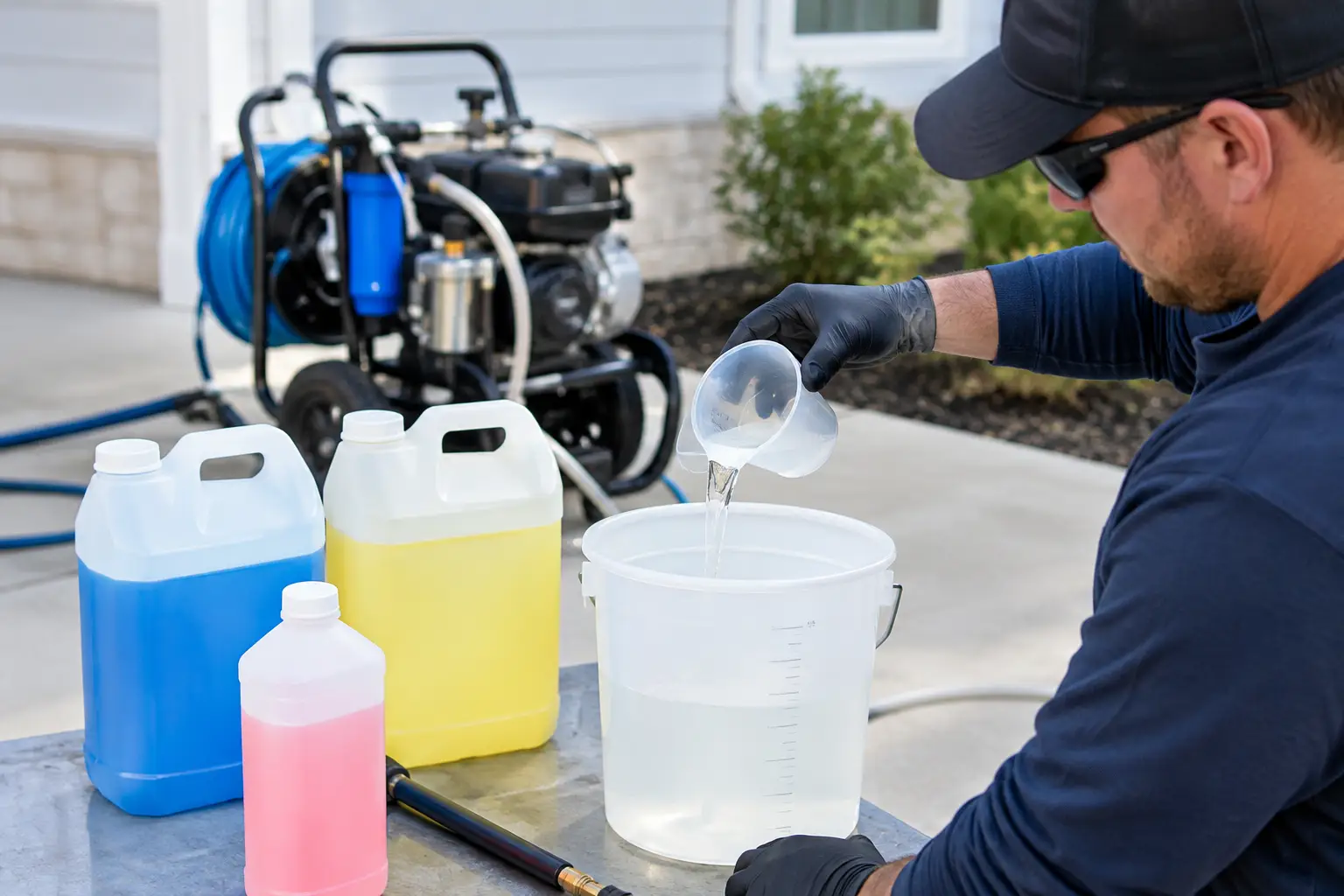
A roof mix that worked perfectly last week can underperform today for one simple reason: the chemical coming through the gun is not the chemical you think you mixed in the tank. To calibrate soft wash chemical ratios, you need to measure the whole system - your source strength, water volume, draw rate, and actual output - instead of relying on a valve position or a rough bucket estimate.
For a professional cleaning operation, this is not chemistry for chemistry's sake. A mix that is too weak wastes labor and repeat visits. A mix that is too hot can discolor painted surfaces, stress vegetation, damage sensitive materials, and create a claim that costs more than the job. Calibration gives you a repeatable starting point, then lets you adjust for the surface and the growth in front of you.
Start With the Chemical at Its Actual Strength
Most sodium hypochlorite-based soft wash work begins with the percentage on the drum. That number matters, but it is only the source concentration. It is not the percentage that reaches the roof, siding, concrete, or fence.
A common example is 12.5% sodium hypochlorite. If you put 25 gallons of 12.5% product into a 100-gallon finished batch and fill the remaining 75 gallons with water, the tank mix is approximately 3.125% before surfactant. The basic calculation is straightforward:
Source strength x chemical volume ÷ total finished volume = tank strength
In that example, 12.5 x 25 ÷ 100 equals 3.125%. If the product in the drum has aged, been stored hot, or sat through a long season, it may no longer test at 12.5%. Chlorine loses strength over time, especially when it is exposed to heat and contamination. Contractors who buy in volume should treat the labeled percentage as a starting assumption, not a field measurement.
Test strips and a proper chlorine test kit are inexpensive compared with running several hundred gallons of an unknown mix through a job. Check new deliveries when accuracy matters, and keep your chemical out of direct sun and away from heat sources. Never store sodium hypochlorite with acids, ammonia, fuels, or incompatible cleaners.
Calibrate Soft Wash Chemical Ratios at the Gun
Your batch may be right and your applied mix may still be wrong. This is where many soft wash setups get misjudged. Proportioners, downstream injectors, metering valves, and dual-feed systems all introduce variables. A valve marked at 50% is not a promise that 50% of your output is chemical.
The fastest field method is a timed draw test. Set the system exactly as you would for the job: same pump speed, same hose length, same gun and nozzle, same valve position, and the same tank levels if possible. Run the water or chemical feed into a marked container for 60 seconds. Measure the collected volume, then repeat the test for the other feed path.
If your system draws 2 gallons of chemical and 6 gallons of water in one minute, your output is 25% chemical and 75% water. If the chemical tank contains a 3% mix, the material at the gun is roughly 0.75% sodium hypochlorite before accounting for any additional rinse water or drift. That may be appropriate for light siding algae, but it will not perform like a 3% roof mix.
For dual-tank systems pulling straight product from one tank and water from another, use the same math. If the system pulls 1 gallon of 12.5% sodium hypochlorite and 4 gallons of water, the applied strength is 2.5%. The calculation is 12.5 x 1 ÷ 5.
Write the results down. A simple record of valve setting, nozzle, hose length, draw rate, and resulting percentage turns guesswork into a usable setup sheet. It also makes training another technician much easier.
Why hose, nozzle, and pump speed matter
Anything that changes flow can change proportioning. A partially clogged filter, a worn pump, a restricted pickup tube, a different nozzle, or another 100 feet of hose can alter how the system draws. So can changing from one gun to another or running a variable-speed pump at a lower setting.
That does not mean you need to test before every house wash. It means you should recalibrate after a major equipment change, after a repair, when switching hose configurations, and anytime job results stop matching your normal expectations. If your system suddenly needs more dwell time than usual, verify the mix before blaming the chemical or the weather.
Build the Mix Around the Job, Not a Habit
There is no single "correct" soft wash ratio. The right percentage depends on organic load, surface type, temperature, dwell time, runoff control, and the customer's tolerance for a second application versus a stronger first pass.
Light green algae on vinyl can often respond to a low applied percentage with good dwell time and a compatible surfactant. Heavy black roof staining, thick lichen, or neglected commercial masonry may require a stronger approach, careful staging, and multiple controlled applications. More chemical is not automatically faster if the surface is dry, hot, poorly pre-wet, or allowed to dry before the mix can work.
Start by identifying what you are removing. Organic staining responds differently than rust, efflorescence, oxidation, grease, or tire marks. Sodium hypochlorite is a tool for organic growth. It is not the answer to every stain, and forcing it onto the wrong problem creates wasted chemical and frustrated customers.
Surface condition matters just as much. Oxidized siding, old paint, bare wood, anodized aluminum, exposed metal fasteners, and delicate landscaping all demand more restraint. A lower percentage, shorter dwell time, smaller work sections, and thorough rinsing may be the better business decision. On a roof, follow the roofing manufacturer's guidance and avoid treating runoff management as an afterthought.
Use a Jar Test to Check Your Math
A jar test is a practical way to confirm a proposed tank ratio before committing a full batch. Use clean, clearly marked containers and scale the same proportions down to a manageable amount. For example, a 3:1 water-to-chemical ratio can be tested with three parts water and one part chemical.
The jar test confirms your mixing math, but it does not replace a draw-rate test. A batch can be mixed correctly and still leave the gun at the wrong strength because the proportioner is pulling unevenly. Use the jar test to establish tank concentration, then use timed draws to establish delivery concentration.
Surfactant should be added according to its label and the job requirements. It can improve cling and make it easier to see coverage, but it changes neither the sodium hypochlorite percentage nor the need for accurate measurement. Overdoing surfactant can create excessive foam, complicate rinsing, and make runoff harder to manage.
Protect the Job While You Test
Calibration should happen in a controlled area, not while you are learning on a customer's new siding. Wear the PPE specified on the chemical safety data sheet, use compatible containers, and keep separate measuring tools for incompatible products. Label every tank and valve clearly enough that a tired technician cannot make an expensive mistake at the end of a long day.
Before treating a full elevation, test a small, inconspicuous section. Watch the reaction, confirm dwell time, and inspect for color change or surface sensitivity. Pre-wet vegetation where appropriate, assign one person to water protection on higher-risk jobs, and do not let chemical dry on glass, metal, or painted finishes.
When a pump, proportioner, check valve, or pickup line is not behaving, do not compensate by blindly increasing the tank strength. Find the restriction, air leak, worn seal, or failed component first. A system that cannot draw consistently cannot deliver consistent results. At Dieter's Industrial, that is the same rule applied in the repair bay: diagnose the actual failure before replacing parts or changing the process.
Keep a Ratio Sheet With the Rig
The best calibration is the one your crew can repeat. Keep a laminated ratio sheet with the rig showing your tested tank recipes, normal draw settings, expected applied percentages, and the equipment configuration used for each test. Include the date and source strength of the chemical when it was tested.
That sheet is not a substitute for judgment. Heat, humidity, shade, growth level, and surface condition still matter. It is a dependable baseline that keeps the crew from starting every job with a guess. Measure the system, document what it delivers, and let the surface tell you whether the next adjustment should be stronger, weaker, slower, or simply more patient.