

Dairy Farm Washdown Pressure Washer Basics
A dairy barn stays clean because the machine moves enough water, handles the soil load, applies chemistry correctly, and is ready to run when the washdown window opens. Here is how to size one for the job.
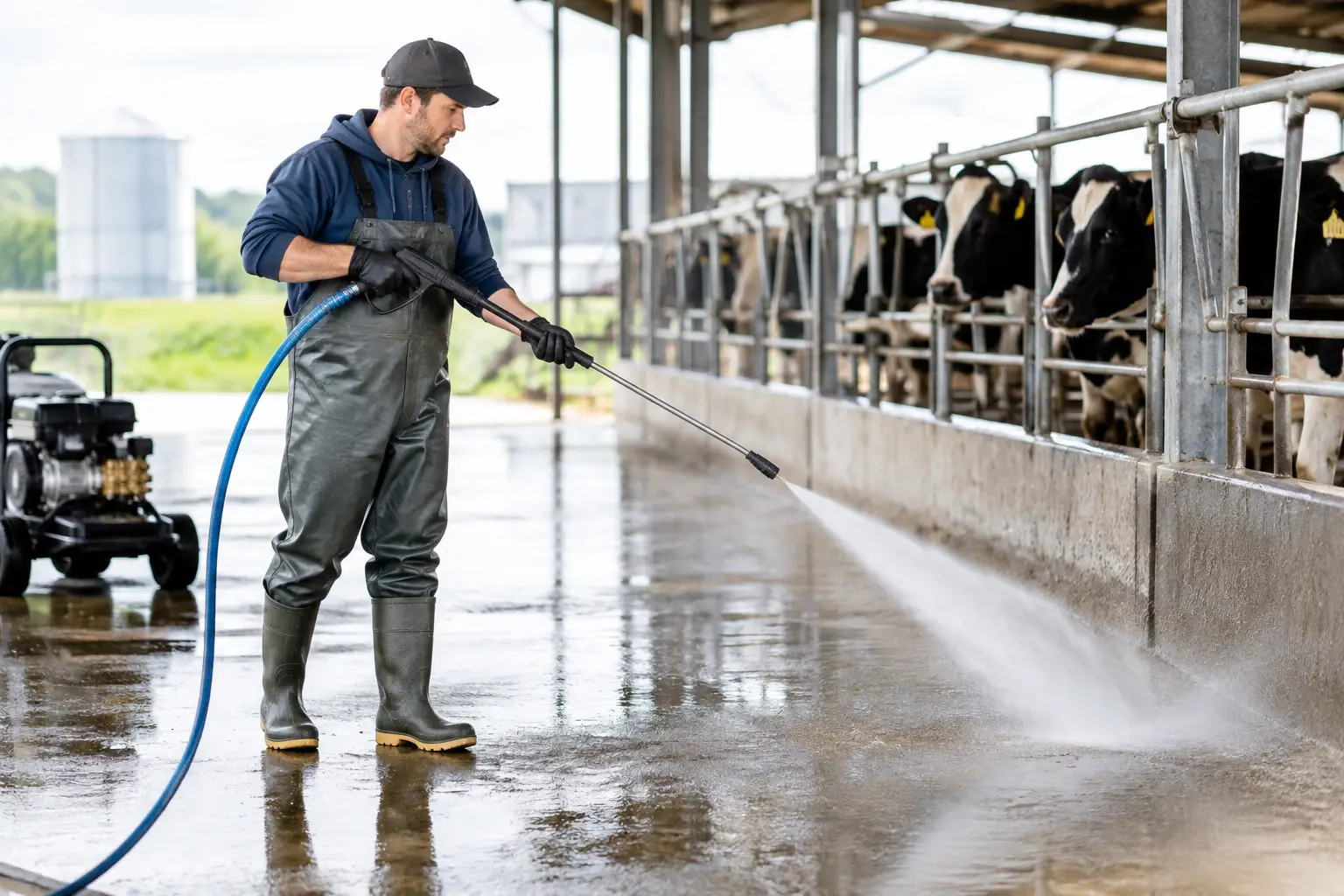
A dairy barn does not stay clean because someone owns a pressure washer. It stays clean because the machine moves enough water, handles the soil load, applies chemistry correctly, and is ready to run when the washdown window opens. A dairy farm washdown pressure washer has to deal with manure, bedding dust, milk-house residue, feed alleys, equipment, and changing weather. That is commercial work, not a job for a homeowner machine that spends most of its life in a garage.
Start with the job, not the catalog. The right washer depends on what you are cleaning, how often you clean it, where the water comes from, and whether hot water is practical in that location. PSI matters, but it is only part of the answer. (For the bigger picture on dairy and agricultural washdown, start there.)
Start With Flow, Then Set the Pressure
For routine barn washdown, gallons per minute usually determine productivity more than a sky-high PSI rating. Flow carries loosened manure, bedding, and detergent away from the surface. A machine with adequate GPM lets an operator rinse wider areas faster and keeps washdown from turning into an all-day chore.
A 4 GPM commercial unit can be a workable starting point for lighter, smaller washdown duties. Larger freestall barns, parlors, holding areas, equipment bays, and frequent cleanup schedules often justify 5.5 to 8 GPM. More flow is not automatically better, though. Your water supply, drain capacity, hose size, and operator control all have to support it. (The trade-off is laid out in how to choose pressure washer PSI and GPM.)
Pressure should match the surface. Rough concrete can tolerate more force than painted panels, curtain systems, electrical enclosures, rubber flooring, livestock equipment, or aging grout. Many dairy applications work well in the commercial 2,500 to 4,000 PSI range when paired with the proper nozzle and stand-off distance. Excess pressure can drive contamination into damaged concrete, strip coatings, cut seals, and turn a cleaning job into a repair bill.
A common mistake is buying the highest PSI machine on the shelf, then fitting it with a small nozzle to make it feel even stronger. That can overload the pump, make the gun hard to control, and slow rinsing. The nozzle must be sized for the machine's actual GPM and pressure rating — the nozzle sizing calculator will give you the right orifice.
Hot Water Versus Cold Water in a Dairy Barn
Cold water handles plenty of dairy washdown work when the goal is to remove fresh manure, mud, bedding dust, and general organic buildup. It is simpler, costs less to purchase, and avoids burner maintenance. For a barn where washdown is frequent and soils do not have time to bake on, a cold-water machine may be the sensible choice.
Hot water earns its keep around milk houses, processing-adjacent areas, greasy equipment, skid loaders, service bays, and locations with oil or fat-based residues. Heat helps detergents work and cuts through material that cold water alone tends to smear around. It can also shorten cleaning time when the soil load is heavy.
The trade-off is straightforward. A hot-water pressure washer has a burner, fuel system, coil, safety controls, and additional service requirements. It needs clean fuel, proper winter storage, adequate ventilation, and operators who understand that a burner problem is not fixed by simply turning up a thermostat. If the machine will run indoors, exhaust management and local safety requirements need to be addressed before it arrives.
Do not confuse hot water with sanitation. Heat can improve cleaning, but a washer does not replace a documented sanitation program, approved chemicals, contact time, or the procedures required for food-contact areas. Clean first, then use the right chemical process for the area and the farm's requirements. (More on the parlor itself in cleaning a dairy parlor.)
Water Supply Can Make or Break the Machine
A pressure washer cannot produce water that the supply line cannot deliver. If a 5.5 GPM machine is fed by a weak well system, a restrictive hose bib, a clogged screen, or undersized plumbing, it may cavitate. Cavitation sounds rough, causes pressure fluctuation, and can damage pump components over time.
Before selecting a dairy farm washdown pressure washer, verify the available flow at the actual connection point. Check supply-hose diameter, inlet filters, float tanks, and whether other water demands occur during washdown. A buffer tank can make sense where water supply is inconsistent, but it must be sized and plumbed correctly. It is not a cure for every water problem.
Water quality matters too. Hard water creates scale inside coils, valves, and fittings. Sediment wears pump seals and plugs nozzles. If your farm uses well water with known mineral or sediment issues, build filtration and maintenance into the equipment plan from day one. Replacing a nozzle is cheap. Replacing a scaled hot-water coil or worn pump is not.
Build the Setup Around the Barn, Not Just the Washer
The machine is only one part of a washdown system. Long hose runs create pressure loss and wasted walking. A fixed hose reel near the work area can improve daily efficiency, provided the hose is rated for the machine and protected from traffic. In a busy barn, hose routing matters as much as cleaning speed. A hose run across a drive lane is a short path to damage.
Choose guns, lances, nozzles, and quick-connects that operators can use with gloves on. A 40-degree nozzle is useful for broad rinsing. A 25-degree nozzle provides more cleaning force. A soap nozzle or downstream injector can handle appropriate detergent application. Reserve zero-degree nozzles for rare, controlled work. They can damage concrete, seals, plastic, and people in a hurry.
For large flat concrete areas, a properly matched surface cleaner can reduce overspray and improve consistency. It is not the right tool for every manure-covered floor or uneven surface, but it can save time in certain parlors, equipment pads, and service areas. The key is enough GPM to run it properly. A surface cleaner that is too large for the machine will leave stripes and disappoint the operator.
Chemical Application Needs a Plan
Pressure alone does not solve every washdown problem. The right detergent helps break the bond between the soil and the surface, allowing lower pressure and faster rinsing. The wrong chemical can damage aluminum, galvanized components, paint, rubber, or sensitive surfaces.
Downstream injection is simple and keeps concentrated chemical out of the pump, but it delivers a relatively diluted mix and is limited by nozzle selection. A dedicated chemical application system gives more control when stronger solutions or specific dwell times are needed. Either way, keep detergents clearly labeled, train operators on dilution, and never let chemical choices interfere with animal health, milk-house procedures, or wastewater rules.
Plan for Winter and Downtime Before They Cost You
In Central Pennsylvania, freeze damage is one of the most preventable pressure-washer failures. A pump, coil, hose, or float valve can crack after one hard freeze. If the unit cannot live in a heated area, winterize it whenever freezing temperatures are possible. Running water out is not enough. Use the correct pump-protection solution and follow the machine's winterization procedure.
Daily checks are simple: inspect the inlet screen, oil level, hoses, gun, fittings, and nozzle. Watch for leaking quick-connects, pulsating pressure, unloader cycling, burner smoke, or a machine that takes longer than usual to build pressure. Those are early warnings, not quirks to live with.
When pressure drops, do not immediately blame the pump. Start with the nozzle, inlet water supply, filters, air leaks, and unloader settings. A worn nozzle can reduce working pressure substantially. A restricted inlet can starve a healthy pump. Good troubleshooting prevents expensive parts from being replaced for the wrong reason — when a pressure washer won't build pressure walks through the order to check things.
Buy for Serviceability, Not Just the Sticker Price
A washdown machine that is down during a scheduled cleanup is not a bargain. Look for commercial-grade pumps, accessible service points, standard fittings, and parts support that will still be available years from now. Ask who can diagnose the burner, rebuild the pump, service the coil, and supply a hose or unloader when one fails.
Dieter's Industrial sees the difference between a machine selected for the job and one selected because it had an attractive price tag. The right unit may cost more up front, but it should match the farm's water supply, cleaning schedule, soil load, and service reality. Just as important, it should be a machine your team can operate safely and maintain without guesswork.
Give the equipment a clear place in the washdown routine, protect it from freezing and abuse, and address small changes in performance early. That is how a pressure washer stays a useful tool instead of becoming another piece of equipment waiting for repair — and when one is already waiting, bring it to the repair bay.