

Pressure Washer Detergent for Fleet Washing
A fleet can look washed and still carry the gray road film that makes trucks look neglected by the next stop. Choosing detergent means matching the soil, the surface, the wash method, the water temperature, and the equipment supplying it.
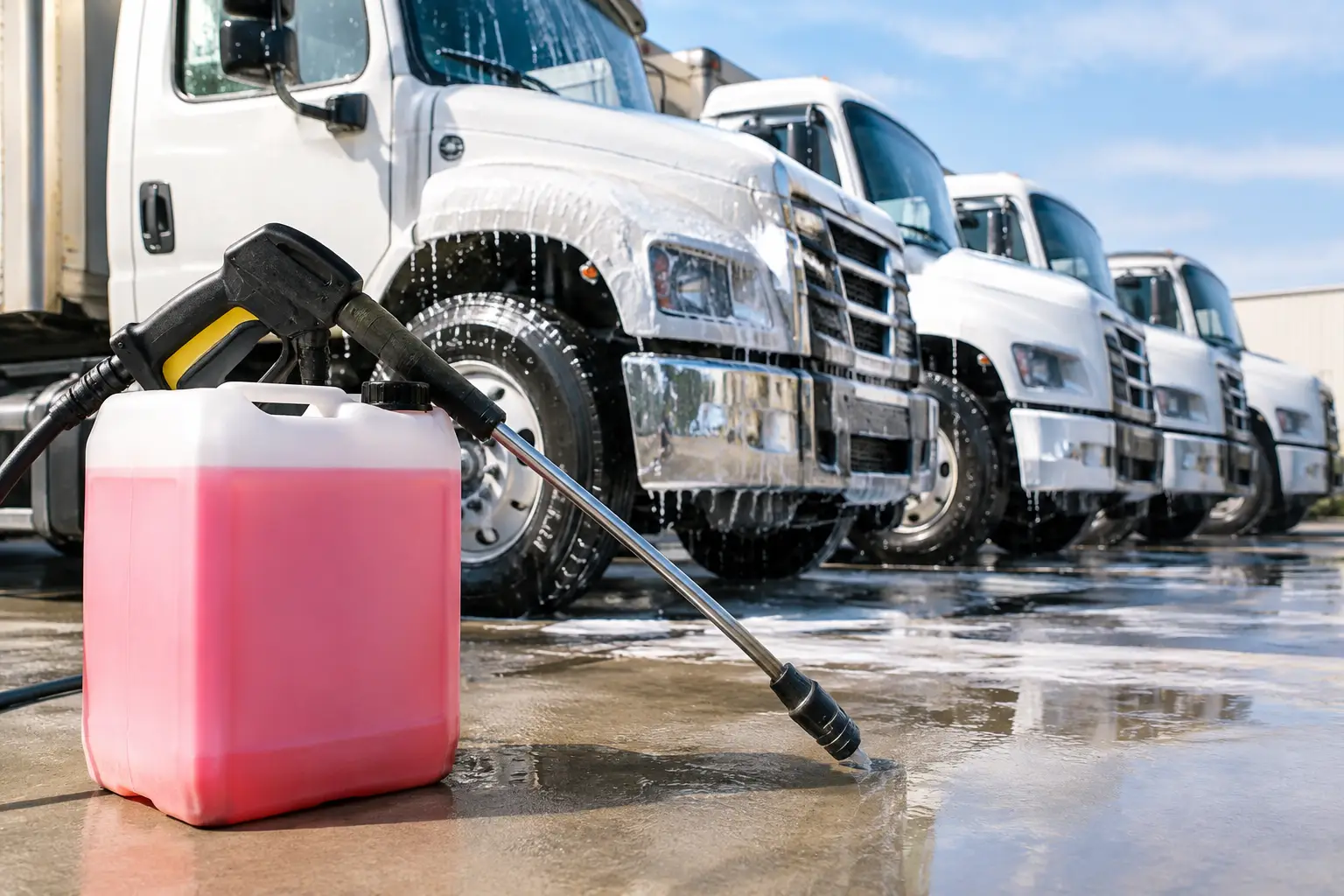
A fleet can look washed and still carry the gray road film that makes a customer's trucks look neglected by the next stop. That is why choosing pressure washer detergent for fleet washing is more than buying the strongest chemical on the shelf. The detergent has to match the soil, the surface, the wash method, the water temperature, and the equipment supplying it.
For a contract washer or an in-house maintenance crew, chemical selection affects labor time, water use, equipment wear, and how consistently the fleet comes out. Start with the job, not the catalog.
What Fleet Soil Is Really Made Of
Most fleet washing is not a single-soil problem. Road film is usually a layered mix of diesel exhaust residue, oily mist, tire dust, carbon, salt, clay, and whatever the route picked up that week. Box trucks, delivery vans, dump trucks, refuse equipment, tractors, and municipal vehicles may all be parked in the same yard, but they do not need the same wash chemistry.
A general-purpose alkaline detergent is often the right starting point for painted commercial vehicles with normal road film. Alkalinity helps break the bond between oily soil and the surface so the rinse can carry it away. The detergent also needs surfactants that wet the panel evenly and hold loosened dirt in suspension instead of letting it redeposit farther down the truck.
That said, more alkaline is not automatically better. Strong caustic products can dull polished aluminum, stain bare metal, affect anodized parts, and create problems on sensitive decals if concentration and dwell time are not controlled. They can also turn a routine wash into a customer callback. Read the product label, verify compatible surfaces, and test an inconspicuous area before putting a new chemical on an entire fleet.
Choose Detergent by the Job, Not the Vehicle Count
A wash contractor may clean 30 tractors one night and 30 light-duty service vans the next. The number of vehicles matters for chemical volume and workflow, but the soil load determines the detergent.
For light to moderate road film on painted trucks and vans, use a fleet wash detergent formulated to rinse clean without leaving residue. These are usually the workhorse products for recurring accounts where appearance matters and soils are controlled through regular service.
For heavy equipment, construction fleets, farm machinery, and trucks exposed to hydraulic oil or grease, a heavier-duty alkaline degreaser may be needed for lower panels, chassis areas, fifth wheels, and engine compartments. Do not treat the entire vehicle with a high-strength degreaser just because the undercarriage is filthy. Apply the stronger product where the contamination is, then use a vehicle-safe wash detergent on painted body panels.
For aluminum tanks, bright metal, polished wheels, or trailer components, slow down and identify the surface first. Acid brighteners can remove oxidation and mineral staining, but they are not routine fleet soap. Used incorrectly, they can etch glass, damage adjacent finishes, and create a serious safety issue for the operator. Acid work calls for correct dilution, proper personal protective equipment, controlled application, and a thorough rinse.
Salt deserves its own plan. Winter road treatment can lodge in seams, undercarriages, brake areas, and frame components where a quick body wash does little good. Use a detergent that can help release traffic film, then put time into a complete low-pressure pre-rinse and rinse-out of the areas where salt stays trapped. The chemical helps, but coverage and rinse volume do much of the corrosion-control work. (More on cold-weather work in washing a fleet in winter.)
Hot Water Changes the Chemical Conversation
Hot-water pressure washers are a major advantage for fleets carrying petroleum soil, exhaust residue, and greasy road film. Heat lowers the viscosity of oils and helps detergent work faster. It can reduce dwell time and the amount of chemical needed to get a clean rinse.
A hot-water machine does not excuse poor detergent selection or excessive mix strength. If the soap is too aggressive, hot water can make surface damage happen faster. If the detergent is weak for the job, operators often compensate by turning up concentration until cost and risk climb with it.
Cold water can still do productive fleet work, especially on regularly maintained vehicles and lighter soils. It generally requires more attention to detergent dwell time, agitation where needed, and rinse technique. On a cold-water rig, a detergent with good wetting and road-film removal properties is often worth more than a bargain soap that forces a second pass.
Get the Mix Ratio Right at the Vehicle
The dilution printed on a detergent pail is only useful if you know what reaches the panel. Injector draw rates, hose length, nozzle selection, water flow, and downstream versus upstream application all change the final concentration.
Downstream injection is common because the chemical does not travel through the pump, coil, and high-pressure hose. It is safer for the equipment and simple for routine fleet washing. The trade-off is dilution. A downstream injector may provide a useful wash mix for normal road film but may not deliver enough strength for heavy grease removal.
Upstream injection and pump-fed chemical systems can apply stronger solutions, but they require a detergent specifically approved for that path and equipment built to handle it. Caustic products sent through the wrong pump, fittings, seals, or coil can shorten component life. A chemical savings that costs a pump or unloader is not savings.
Measure your actual draw rate. Fill a marked container with water, run the injector for a timed interval, and calculate how much chemical it pulls. Then verify performance on a representative dirty vehicle. This tells you more than guessing from a knob position.
Dwell Time, Application, and Rinsing Matter as Much as Soap
A good detergent needs time to work, but it cannot be allowed to dry on the surface. Apply from the bottom up to reduce streaking, keep panels wet, and give the product a few minutes of controlled dwell according to its label. On hot, sunny days, work smaller sections and rinse sooner.
Rinse from the top down using enough volume to move soil off the vehicle. High pressure alone does not equal a good rinse. On large fleets, gallons per minute often matters more to production than chasing extreme PSI — see how to choose pressure washer PSI and GPM. A properly sized commercial machine with adequate flow, correct nozzle selection, and a reliable chemical system will clear detergent and suspended soil faster than a high-PSI machine with limited water volume.
Avoid putting a zero-degree nozzle near decals, door seals, electrical connections, wheel bearings, or damaged paint. Fleet washing is repetitive work. A minor technique problem repeated across 40 trucks becomes an expensive problem. The nozzle sizing calculator will tell you the right orifice for your machine.
Watch What the Detergent Is Doing to Your Equipment
Detergent selection is also a maintenance decision. Crystallized chemical in an injector, a swollen hose, a corroded fitting, or a stuck check valve can stop a wash shift just as effectively as a failed pump.
Flush the chemical pickup tube and injector with clean water at the end of the day. Keep detergent containers sealed and protected from freezing. Do not use random household cleaners in commercial equipment because the label sounds close enough. Foaming, corrosivity, viscosity, and compatibility with pump seals all matter.
If a chemical injector stops drawing, do not assume the injector is bad. Check the low-pressure soap nozzle first, inspect the pickup tube and filter for blockage, confirm the ball and spring are free, and look for air leaks. A worn injector is common, but so is a simple setup issue.
Build a Repeatable Fleet-Wash Process
The best fleet detergent is the one that produces a consistent result at a cost that works for the account. Record the product used, downstream or upstream setting, dwell time, water temperature, and any problem areas for each fleet type. That information turns a good crew's habits into a process another crew can repeat.
For new contracts, wash a representative unit before committing to price and production times. Look at the lower panels, fuel areas, rear doors, wheels, and undercarriage, not just the clean side of the cab. If the fleet has oxidation, neglected aluminum, baked-on exhaust, or heavy grease, price that labor separately instead of hoping a stronger mix will make it disappear.
Dieter's Industrial sees the equipment side of this every day: chemicals, injectors, nozzles, water temperature, and flow all have to work together. Pick a detergent that fits the actual soil, verify the mix at the gun, and protect the machine that earns the next wash job — and if an injector or pump is already giving you trouble, bring it to the repair bay.